Life After COVID

Alan Zendell, May 18, 2021

When we consider what life will look like after COVID, the biggest unknown is how many of us will have been vaccinated. The anti-vax movement has been around for two hundred years, even when small pox ravaged the country in the early 1800s. The basic reasons for mistrust of vaccines have remained the same in all that time, but there’s a different twist this time. People cite religious convictions, dislike of science, fear of government control, and suspicion of the pharmaceutical industry. Those generalities haven’t changed, but the details have.

A number of religious sects consider vaccinations an affront to God. We may disagree with that point of view, but the courts have consistently excepted religious orthodoxy from complying with social and health regulations that violated their dogma. Religious objection to the COVID vaccines is a lot more complicated, however.

Particularly in red states, many churches have been caught up in local politics. Ministers who cannot cite religious objections, and who are not remotely qualified to assess the safety and efficacy of vaccines have been politicized by the populist movement of Donald Trump. Trump’s entirely disingenuous opposition to a woman’s right to control her own body, his constant disrespect for science, and his nonstop war with the CDC and the public health experts on his COVID task force made it easy for politically corrupt churches to sow mistrust of the vaccine.

Another aspect of the Trump movement was spreading distrust of the government. There has always been a segment of the population that hated the authority of the federal government, but Trump cultivated it as an art form. Trump’s characterization of the “government swamp,” echoed and amplified by thousands of sycophants, fed that hatred and exacerbated it. The fact that the Trump administration corrupted values and had no respect for truth or facts didn’t prevent it from widening and capitalizing on anti-government sentiment, no matter that Trump’s version of government trampled all over democracy.

The last administration and the Republican Party in the deeply red states made it crystal clear in 2020 that protecting the lives of Americans from COVID ranked far behind craven self-interest, lust for power, and pressure from financial interests that stood to profit from preventing a locked down economy. That has continued into the Biden administration, as the Republican establishment would rather frustrate President Biden’s efforts to save lives than eradicate the pandemic.

With respect to the COVID vaccines, the unfortunate truth is that there are a lot of unscrupulous politicians who lack the courage to take on the Trumpers and dispel their lies. Even worse is the enormous number of Americans who are either too ignorant, too stupid, or simply too lazy to take the trouble to understand. And that raises some critical questions about how we will proceed when the worst of the pandemic is behind us.

It’s important to keep in mind that if a vaccine is 95% effective, even in a crowd of vaccinated people one in twenty are likely to be infected if they are exposed to the virus, and that number could be higher with the more deadly strains. If a sizable number of people eschew the vaccines and refuse to wear masks, those individuals will remain a threat to everyone else.

Let’s talk about mass transportation – buses, planes, and all variety of rail travel, from crowded commuter lines to overnight long-distance trains. Should people who have refused to be vaccinated be allowed to jeopardize the health of millions of others, or should we require proof of vaccination before they can purchase tickets? Should employers have the right to refuse to allow workers back into cleansed facilities without proof of vaccination? And what about indoor sports venues and high-density retailers like box stores and super markets? Should people who frequent dating websites have to reveal their vaccination status?

Consider one example. A quarter of a million passengers, mostly seniors, ride the auto train between Virginia and Florida every year. The trip averages 18-20 hours each way, and AMTRAK currently requires passengers to wear masks for the entire trip including an additional several hours prior to departure and waiting for their cars to be debarked when they arrive. Call it twenty-two hours in a mask, which most people would consider intolerable. If a fourth of the population refused to be vaccinated, AMTRAK would only have two options: continue the mask requirement indefinitely, or restrict ticket sales only to people who can prove they received one.

We shouldn’t be arguing about vaccines. And we shouldn’t allow a bunch of irresponsible morons to dictate how the rest of us live in the future. If it were up to me, proof of vaccination would be required to register to vote. I bet the Trumpers would love that.

Posted in Articles | Tagged , , , , , , , , , , , , , | Leave a comment

The American Renewal Project

Alan Zendell, May 14, 2021

Dystopian futures fascinate us. Whether it’s an alien invasion, a zombie apocalypse or a nuclear holocaust, we are irresistibly drawn to tales describing how our country or our world might be destroyed. As early as 1897, H. G. Wells’ War of the Worlds told us how Martians might appear in our skies and inexplicably but unstoppably destroy everything in their path. In 1938, Orson Welles moved the Martian attack from London to New Jersey and terrified the nation with a radio play. We really love that stuff; the story has made it into at least five film versions.

In 1932, Aldous Huxley’s Brave New World showed how specialized genetic breeding could destroy us, and in 1949, the experience of autocrats like Hitler, Mussolini, and Stalin brought us George Orwell’s 1984, a reminder of how fragile democratic society is and how easily it might be overthrown. In 1957, Neville Shute horrified us with his story of nuclear war and radioactive fallout destroying humanity. In 1985, Margaret Atwood’s A Handmaid’s Tale, told of a crisis resulting from environmental irresponsibility turning America into a religious dictatorship in a mere fifteen years, a future that’s no less terrifying because it makes no sense, whereas the 2014 film Interstellar realistically portrays a dying Earth becoming toxic to human life.

Those stories got our attention despite frequently failing to plausibly explain how we got from here to whatever dystopian future they proposed. The most chilling one I’ve read, because it offers a detailed, realistic timeline of events rooted in today’s world leading to total domination by China, was David Wingrove’s marvelously believable Chung Kuo novels of the 1990s. They’re relevant because Wingrove’s dystopia grew out of extreme nationalism, isolationism, and failure to recognize obvious, growing threats until it was too late – an apt metaphor for the direction Trumpism is taking us.

Donald Trump’s vision of the future is naïve and sophomoric. It focuses only on Donald Trump, not what America needs to remain viable. It trashes our alliances, is averse to confronting autocratic adversaries, and is tearing America apart from within.

Our republic was in serious jeopardy from rank partisanship and the fight to prevent a massive transfer of wealth to nonwhite Americans long before Trump was a political force. Before the formation of the Tea Party, the Republican Party was rooted in conservative principles and adherence to the Constitution. There were sharp ideological differences, but political leaders managed to disagree without losing sight of the real goal. Somehow, what was best for the country came first when it was most important.

But today, soulless politicians like House Minority Leader Kevin McCarthy, who like Trump, care only about their own political power, are an existential threat, supporting Trump’s alternate reality that ignores facts and in which recent history is rewritten daily. Former Trump Chief of Staff Mick Mulvaney had the chutzbah to tell a televised press conference that truth is whatever the victors say it is after the fact. The Republican Party has fallen down the Trump rabbit hole. Its recent actions may destroy not only the party but the ability of the government to function at all.

The passive protagonists of our dystopian fantasies were always unable to see impending disaster until it was upon them. Misguided Republicans led by McCarthy are likewise leading themselves and the rest of us down a path to ruin. One group of Republicans, however, has decided to fight back. More than 100 prominent former elected officials and the people behind the Lincoln Project that helped defeat Trump in 2020 created A Call For American Renewal. Its mission statement is simple:

[W]hen in our democratic republic, forces of conspiracy, division, and despotism arise, it is the patriotic duty of citizens to act collectively in defense of liberty and justice. We, therefore, declare our intent to catalyze an American renewal, and to either reimagine a party dedicated to our founding ideals or else hasten the creation of such an alternative.

They are committed to taking their party back from Trump, and failing that to form a third party based on conservative values, but one that is centrist and willing to negotiate, rather then being extreme and obstructionist. They understand that failure to act would be disastrous.

The American Renewal project would prefer to throw the Trumpers out of their party, a prospect that seems unlikely in the immediate future, but I believe it would be best for our future if they proceed with the creation of a powerful third party. Trumpism aside, there is no other way to break the partisan gridlock, which will surely destroy us one day. A third party will marginalize extremists and create a new platform for centrists and constitutional conservatives of conscience.

A viable third party will end Trump’s reign of terror in primary elections. More importantly, it will break the stalemate of extremists on both side of the aisle by creating a third side with whom both the right and left will have to negotiate to govern. Coalition governments have their own risks, but the rest of the world has shown that they work where gridlocked governments fail. Regardless of which side you’re on, politically, supporting the American Renewal is in everyone’s interest.

Posted in Articles | Tagged , , , , , , , , , , , , , , , , , | 1 Comment

Saving Our Democracy

Alan Zendell, May 9, 2021

Sometimes, it’s necessary to get out of the weeds and adjust our perspective. Context is everything. That’s truer for the current struggle for control of the Republican Party than anything else happening in America. Suppressing the pandemic and repairing our economy suck up most media time these days, but while most Americans find that preferable to beginning each day with a fresh batch of hateful tweets and Facebook postings by Donald Trump, there’s a downside to his being banned from the two major social media platforms.

The eighteen-month long Trump Blitzkrieg of the 2016 election cycle caught the Republican Party by surprise. The country hadn’t seen a populist movement like Trump’s in almost a century when organizations like the Ku Klux Klan and the German-American Bund (the American annex of Hitler’s Nazi Party) were allowed to spread their toxic propaganda for decades, until the government perceived them as a major threat to national security.

Trumpism is different from those earlier movements and far more dangerous to our democracy. Trumpism is based on a philosophy (if, in fact, it has one) that’s only subtly different from the hateful rhetoric of the past, its similarities much more striking than its differences. Like predecessor movements, it is based on an appeal to our basest instincts, our centuries of xenophobic conditioning that we can only trust people “like us.” Everyone else is simply out to take what’s ours, whether it’s our land, our wealth, or our women.

Trumpism is a bigoted, elitist, misogynistic view of America that we thought we had largely outgrown, but Trump proved that it had simply gone underground, awaiting the arrival of a spiritual leader to set it free. In a very real but horribly distorted way, they see him as the Second Coming, although a more fitting description might be the Antichrist. If Trump’s hateful, divisive brand of governing is allowed to dominate the Republican Party, it can only damage our future.

We’ve always had political differences. Our system of government, like our judicial system, was designed to be adversarial. The idea of free speech and democratically elected leaders was an attempt to assure that competing views and philosophies would be debated before major decisions were made. Our founders knew about monarchies and the evils of autocratic rule, but they had no concept of the kind of modern-day fascism after which Trumpism modeled itself.

Thus, the fifteen other Republican candidates for President in 2016 were unprepared for Trump’s Storm Trooper tactics. Either they didn’t realize that allowing their individual ambitions to guide their decisions would allow Trump to divide and conquer them, picking them off one at a time like a lion going after a herd of elands in the savannah, or they were too self-absorbed to put aside their egos and organize to stop him.

As a result, we had four years in which America took steps backward in every aspect of American life. We saw the result of a president and a bunch of sycophant politicians who valued their individual power more than human life, and we found ourselves isolated from our allies as a bumbling administration did everything possible to help our enemies flourish. We saw centrists marginalized and forced out of government, replaced by people like Matt Gaetz, Marjorie Taylor Greene, Josh Hawley, Mo Brooks, and Ted Cruz.

Consider a future in which these people, in the name of Donald Trump, are allowed to take over the Republican Party, and they are successful in implementing the voter suppression laws we have already seen passed in four states. If those laws are allowed to dominate future elections, we will have replaced a two-party system designed to address differences with debate and negotiation with a fascist style of leadership that brooks no opposition.

We’re all exhausted from the pandemic and the fifteen-month disruption in our lives. We’re adjusting to lost love ones, unemployment levels not seen since the Great Depression, and the sheer madness of anti-vaxxer propaganda. Trump is taking full advantage of this national ennui, operating under the radar as he undermines what’s left of the traditional Republican Party one state at a time. He’s counting on the fact that like his 2016 opponents, Americans won’t wake to the danger until it’s too late.

Today, this very minute, Americans who care about the future of our country are faced with two questions. Are we willing to trade the admittedly imperfect, inefficient system designed by our founders for one in which those in power have no respect for the Constitution, the rule of law, or basic human rights? And if not, what are we willing to do to prevent them from taking over? If you’re not terrified yet, you should be.

Posted in Articles | Tagged , , , , , , , , , , , , | 3 Comments

The Enemy of My Enemy

Alan Zendell, May 6, 2021

As the Biden administration moves to get COVID under control and counter the stupidity of anti-vaxxers, Americans are responding positively. He has consistently polled better than his predecessor since the day he took office. There’s no doubt that the majority of Americans approve of the way Biden is leading the country, and that only a relatively small minority (I estimate it as less than 30%) support Trump and his Big Lie that the election was stolen. Despite those impressive and unusually consistent numbers, the two most important political issues in our country today are partisan gridlock and who controls the Republican party.

For people who believe, as I do, that Biden’s fight for the soul of our nation is critical to our future, there’s a bitter irony in that observation. Two decades ago, Dick Cheney, as Secretary of Defense and Vice President under George W. Bush, drew the ire of the country as the evil genius who pushed President Bush into the twenty-year war in Iraq and Afghanistan, based on false intelligence about weapons of mass destruction and considerable financial self-interest. His politics were considered extreme, Reaganism on steroids. The positions Cheney convinced Bush 43 to take were largely responsible for his presidency ending with one of the lowest approval ratings in our history.

One decade ago, with Dick Cheney out of politics, his daughter Liz took up the baton for her father’s brand of conservatism and became a loud voice for Republicans in Congress. In our naivete, those of us who believed the country needed to change direction from war and the financial dangers caused by an unregulated and irresponsible banking system saw Liz Cheney as the enemy, and not without good reason. New York Times columnist Charles Blow reminded us why, yesterday:

• In 2009, she refused to speak out against the birther movement that claimed Barack Obama was not eligible to be president
• In 2010, she labeled Obama’s Department of Justice (DOJ) the Department of Jihad, because of Obama’s alleged support for radical Islam
• In 2016, when the infamous Access Hollywood tapes showed Trump bragging about sexually assaulting women, she said that wouldn’t stop her from supporting him
• In 2017, she reiterated her father’s controversial support for torturing prisoners captured in the war against Al Qaeda

So yes, it was reasonable, until recently, to view Liz Cheney as the enemy if your political beliefs were anywhere to the left of the Tea Party’s. And then, much like her fellow Conservative Jeff Flake did, a few years earlier, she took a courageous stand against Trump’s lies and willingness to subvert the Constitution for his own benefit. It was courageous because it was an almost lone voice among traditional Republicans arguing for principle, and it put her political future in serious jeopardy. She drew a line between politics and the Trump philosophy of winning at all costs. She denied Trump’s Big Lie and stood tall against the wave of Trumpism attempting to retain leadership of her party.

For me, this is another Flake moment, and a far more important one. Senator Flake made me realize that political opposition is a very different thing from undermining the basis of our democracy. Unfortunately, Flake lacked either the courage or the stamina to fight back against his primary challenge in Arizona, and he faded into relative obscurity after the 2018 election. I admired Flake for speaking out against Trump’s abuses and for arguing that Conservatism, as the polar opposite of Progressivism, was a necessary component of a two-party system of government, whereas Trumpism was about the loss of morality and common decency. But where Flake just quit the fight, Liz Cheney is willing to stand alone even it ends her career.

As Charles Blow said, fighting for truth over dangerous lies is a pretty low bar for defining heroism, but I’m not picky. I choose my allies where I find them, and right now, anyone willing to stand up to Trump has my support. Liz Cheney’s politics, like Flake’s, are completely opposite to mine. But integrity is a whole different thing. Without it, our government and our Constitution cannot long survive. I will cheer for Liz Cheney in her attempt to get the Republican Party back on track. I’ll do whatever I can to help her win, and when she does, I’ll fight like hell against her reactionary politics and in favor of Biden’s centrist progressive leadership.

I will likely oppose Cheney’s political philosophy at every turn, but I will thank her for reminding us that democracy only survives when both sides are free to fight for what they believe, if what they believe in is the future of our country.

Posted in Articles | Tagged , , , , , , , , , , , | 1 Comment

Irreconcilable Differences

Alan Zendell, May 5, 2021

Marriages break up for various reasons, the most common of which is “irreconcilable differences.” That’s another way of saying that in the absence of flagrant adultery or spousal abuse, couples drift apart, and rather than attempt to resolve their differences, they often let them grow and fester.

Differences exist in all relationships. They can be a source of growth, strengthening the bond, or they can be destructive and divisive. With open communication and a mutual willingness to invest the requisite time and energy, they can be bridged, but when they become extreme, it can be impossible to find common ground. When that happens there is no recourse but divorce.

All relationships are fragile. They require care and nurturing, and that’s equally true in the politics of a two-party democracy. Differences between Republicans and Democrats have always existed, but in the past, people of good will have found ways to come together and overcome them. Our system has endured until now because no matter how sharp our differences, there always came a time when responsible people put country ahead of personal gain and ideology. Our republican form of government survived wars and economic disasters but there is no guarantee that it will survive internal pressures tearing it apart.

In the decades since Ronald Reagan declared that the government was more a source of problems than solutions, and Republicans realized that if they continued to depend on white, working class voters to retain power, we’ve seen an erosion of the basic notion that the Constitution and the general welfare of all Americans must always be our guiding principles. In the face of population shifts in diversity and education which would inevitably relegate their traditional base to minority status, Republicans had an existential choice – expand their tent or rely on lies and restrict voting rights for people who typically voted Democratic.

Despite calls by Republicans who remember what their party was based on, systemic racism, misogyny, and elitism caused the party to drift to the extreme right. Differences and prejudices were exacerbated rather than negotiated, and the result has been the worsening gridlock that dominates Congress and many state legislatures. And that has revealed a glaring weakness in our democracy, an oversight by our founders which may ultimately destroy it if we do not rethink our priorities.

The founders assumed that when push came to shove, patriotism and the Constitution would prevail. They never anticipated that someone like Donald Trump would be willing and able to come to power based on an alternate reality that ignored facts, or that Americans would be gullible enough to be manipulated into thinking that anyone who believed differently was their enemy. The strength of our democracy depends on a loyal opposition. When each side views the opposition only as something to be put down and defeated, we are in serious trouble.

That is the real legacy of Donald Trump whose entire governing philosophy is creating chaos and destroying anyone who is not one hundred percent loyal to him, and for whom nothing matters but his own power and wealth. Rather than heal, Trump prefers to inflame. Since his only real talent is a lynch mob kind of charismatic appeal, and he is completely without scruples, we are being driven to the same end as all those couples who allowed their relationships to erode until there was nothing left to save. Make no mistake – perpetuating the Big Lie that the election was stolen will destroy our country if we allow it to continue.

I just returned from two months in Florida. At the hundred-day mark of the Biden administration, I saw signs everywhere that read, “Don’t Blame Me, I Voted For Trump.” The anger and vitriol of Trump supporters is real and tangible, notwithstanding that they’re based on a deliberate campaign of lies and misinformation promoted by the Republican caucuses in the House and Senate.

That’s why Facebook announced today that it will continue to ban Donald Trump from its platform, and Twitter has shown no inclination to reinstate Trump’s account. Those are the only signs I’ve seen that there is hope for our future. We should be thankful that the two most powerful (and unregulated) social media platforms recognize that truth is more important than profit and popularity.

If only our elected representatives believed that, if they demanded that voices like Liz Cheney’s be heard instead of demonizing her, we might actually emerge from the Trump era stronger than we were. If they don’t, I fear that the American experiment with democracy is doomed.

Posted in Articles | Tagged , , , , , , , , , , , , , , , , , , | 1 Comment

Children and Politics

Alan Zendell, April 28, 2021

The Trump administration shamelessly used children as political pawns in its war against all forms of immigration. The scenes of kids incarcerated at the border and separated from their parents were among the most cringe worthy in an administration that used shock and awe as an everyday propaganda tool. And it didn’t stop there. With public school systems around the country desperate for funds, and many unable to provide badly needed nutrition for kids in poverty in the form of school lunches, the basics of education, and a safe learning environment, Trump’s Secretary of Education made things worse.

With millions of children from underfunded public school systems in urban ghettos and rural America entering high school barely able to read and lacking even the most basic math skills, Betsy Devos used her office to advance the cause of charter and private schools while starving public school systems’ budgets. This, despite fifteen years of promoting charter schools in Michigan, an effort which left that state ‘near the bottom for fourth- and eighth-grade math and fourth-grade reading on … the “Nation’s Report Card.”’

In the post-Trump era, with the death of Rush Limbaugh and the falling star of whacko Alex Jones leaving a vacuum in the world of opportunistic charlatans, Fox News anchor Tucker Carlson has markedly upped his game of spreading lies and confusion. This week he brought American children into his political orbit, demanding that his followers call police or child services whenever they see a child wearing a medical mask. Carlson claims putting masks on our children to protect them and those they interact with from COVID is child abuse. (No, he’s not a moron. He’s just a cynical, immoral shill for right wing political causes.)

The fate of children living in poverty or in working class families that cannot afford private schools has been declining for decades. It’s part of the culture war started in the Reagan years that masqueraded as concerns over government growing and devouring tax dollars. The reality was that Republicans never objected when billions (even trillions) of tax dollars enriched the wealthiest Americans through loopholes and rate cuts. But every attempt to uplift children in need was met concerns about increasing the deficit. The problem, of course, is that investing in the futures of children in poverty largely uses tax dollars to help minorities.

Enter Joe and Jill Biden, whose commitment to our nation’s children is beyond question. President Biden will present his American Families Plan to a joint session of Congress tonight. It’s a bold move that would invest almost two trillion dollars over several years. Its programs will be funded by increasing the tax rate on everyone earning over a million dollars a year, and IRS seriously attacking tax fraud among the wealthiest filers.

The proposed legislation won’t be passed into law in its present form, but it’s a great starting point for negotiation. As summarized in today’s Washington Post, more than half of the proposed $1.9 trillion price tag would go toward “dramatically expanding access to education and safety-net programs for families.”
$200 billion would be invested in pre-K education for all three and four-year-olds, with states chipping in 50% of the cost. $109 billion would fund community college educations for all high school graduates who want one, with states paying 25%. The president also wants to subsidize “tuition for students from families earning less than $125,000 enrolled at historically Black institutions, tribal colleges and other minority-serving institutions for two years.” Imagine how that will play with the far right.

But Biden doesn’t stop there. He wants “225 billion in child-care funding; $225 billion for paid family and medical leave; and $200 billion to extend enhanced Affordable Care Act subsidies” largely aimed at families at children, and a four-year extension of the robust child tax credit that was part of the two COVID stimulus programs. That all adds up to more than one trillion dollars invested in strengthening the financial status of American families.

The American Families Plan is anathema to the Trump wing of the Republican Party, but it will likely poll very well among voters from both parties. Like the Biden stimulus plan and the proposed jobs and infrastructure act, the AFP is expected to earn the approval of at least two of every three Americans. The truth is, that without the long-term agenda of wealthy white racists fighting against a transfer of wealth to people of color and those in poverty, the is no moral or logical reason to oppose it. Once again, it’s up to the voters to make their voices heard in Congress. If you care about the next generation, you have no choice but to speak up.

Posted in Articles | Tagged , , , , , , , , , , , , , , , , , , | 1 Comment

Two States and a Pandemic

Alan Zendell, April 26, 2021

I spent the first twelve months of the COVID pandemic in Maryland, and the most recent two in Florida. Given the craziness of 2020, the public comments by the states’ respective governors, and Trump’s still significant support in Florida, I expected to see a sharp contrast in people’s attitudes and behavior in their response to COVID. I was pleasantly surprised to find that there wasn’t, at least in the purple county where my condo is located.

I shouldn’t have been surprised. My relationship with Florida has been a yoyoing of love and hate for more than five decades. It began on a high note in 1964 when I visited Cape Canaveral to observe a Saturn 1 test firing, but that changed the following year. My next visit began wonderfully – it was my honeymoon in Miami Beach. But three days later, Hurricane Betsy decided to wreck much of southern Florida, turning our honeymoon into a strange tragi-comedy before crossing the Gulf and killing seventy-six people in Louisiana. It continued that way ever since: my brother’s funeral and four more hurricanes, one of which I had to confront three times, being among the low points, and my three grandchildren providing the upside.

Being in Florida for the past two months affected my perspective. Governor DeSantis’ push in 2020 to open the state quickly and ignore CDC’s mask and distancing guidelines so that herd immunity could be achieved through mass infections had horrified me. Likewise, his early voice in the chorus of fake news and denial that the pandemic was real. There was no way I was going to DeSantis’ Florida until my wife and I were both vaccinated.

While I still do not and never will support the callous disregard for human life expressed by both DeSantis and Trump, being here for two months made me see things a little differently. When I left Maryland on February 28th, it was still winter there, and the state was just starting to pull itself out of lockdown. Governor Hogan, one of the few Republican governors to stand up to Trump during the pandemic, managed his state’s response brilliantly. For an entire year, my fellow Marylanders behaved responsibly, following the rules and adapting, thanks to the leadership of Hogan and our County officials (my county in Maryland is also quite purple.)

When I arrived in Florida, winter had miraculously changed to either spring or summer, depending on the day. What a difference! People spent time outdoors, and even those who feared the virus because of pre-existing health concerns could walk on deserted beaches, dine in outdoor restaurants, and resume many of their usual activities. I was pleasantly surprised  that stores required and enforced mask-wearing and distancing as scrupulously as they did in Maryland, and the great majority of people observed them. But a disturbing (to me) number of people are willing to eat indoors in crowded restaurants and many still think Trump won the election. More than once, I heard Anthony Fauci referred to as Satan’s messenger, but I convinced one elderly woman who wouldn’t accept vaccination until God told her to, that Fauci was actually God’s messenger, since God was too busy to talk to everyone personally.

Politics aside, I was reminded that Florida’s economy is heavily dependent on tourism and the service industries. DeSantis’ concern for the financial health of his state is understandable, if not his disregard for ballooning death counts. I was also reminded that Florida faces much harsher challenges from climate change than most states, and it continues to play a leading role in conservation and mitigation efforts, preserving endangered species and protecting the coastline from rising seas levels. Schools have remained open, with options for virtual or in-person learning, and my masked grandsons never missed a day.

In my ongoing ups and downs concerning Florida, I have to rate this visit a plus. Despite the sharp divisions in our country today, I’m pleased to report that if Marylanders get an A for their response to the pandemic, Floridians deserve a B. My family and friends here stayed healthy and all have been vaccinated. I was concerned when I got here, but not any more.

And yet, as much as I want to end this visit on a positive note, I’ve been here long enough for summer to have arrived with its typical Florida intensity. It’s not Florida’s fault, but though I hate to say goodbye to the kids, I will be ecstatic to leave the heat, mugginess, and mosquitos behind when I head north.

Posted in Articles | Tagged , , , , , , , , , , , , | 1 Comment

Time to Stop the Bleeding

Alan Zendell, April 19, 2021

There’s been a rash of deaths associated with gun violence this year. I
divide them into categories: Individual/domestic incidents, mass shootings, and
police-involved shootings. Our attention is sharply focused when something in the
second or third category occurs, but for the sake of perspective, keep in mind
that the numbers in the first group far outweigh the others. Mass shootings and
police shootings horrify us, at least they used to before their frequency made
us numb, but shootings that don’t involve mass casualties or police are the
real horror story: accidents, domestic disagreements erupting into gunfire,
premeditated murder, drive-by shootings, gang wars, bar fights that turn
deadly, muggings – the list is endless.

GunViolenceArchive.org is a non-aligned, nonprofit website that tracks mass
shootings. If you think you’re on top of the numbers, click on the link and
have a look. You’ll find charts and maps like the one below that describe every
mass killing incident in the United States so far in 2021. You’ll be shocked.

2021GunDeaths

In the 109 days between January 1st and April 19th of this year, 12,777 Americans died as a result of gun violence, an average of 117 per day, which exceeds the long term average of 106 I quoted in Americans’ Obsession With Guns. I was surprised to learn that of that number, 7,194, roughly four out of seven, were suicides. Some might argue that a person intent on killing himself would find a way regardless of whether he had a gun handy, but a loaded gun in a desk drawer is awfully enabling.

The other 5,583 were victims. Of that number, nearly a thousand were under 18 (416) or accidental (575). The concentration of dots on the map makes it clear that we’re not talking about hunting accidents – the dots are concentrated around population centers; most deaths due to gun violence occur in or near cities. The conventional wisdom that people in rural areas who own guns generally use them responsibly is thus supported by these data. NRA spokespeople and the Congressional representatives they “own” like to blame cities for the gun violence problem, citing places like Washington, DC and Chicago, both of which have very tough gun control laws. They argue, therefore, that gun control laws don’t work, but don’t buy it. Most of the guns used in crimes in Washington, for example, are purchased in neighboring states like Virginia, which is one of the easiest places in the country to buy one.

What are we to do? Do we keep sending our children to school every day knowing that theirs may be the next one to be locked down because of an active shooter? Do we stop going to events in urban areas that attract crazy people with guns looking for soft targets? And what about people living in cities who kiss their kids good night, not realizing that a gun battle is about to erupt outside their windows between rival drug dealers firing bullets that can easily
pierce the walls of their children’s bedrooms?

As popular pressure mounts for lawmakers to act to curb the number of guns and assure that mentally ill people or criminals can’t access them, we also have to deal with the civil war within the Republican Party. The supporters of Donald Trump march in lockstep to protect gun rights. Any attempts to pass responsible constraints, even those supported by three out of every five
Americans meets with knee-jerk rejection. We can no longer blame the NRA, which is drowning in its own legal and financial problems and not nearly the political force it was in previous  years. The Alt-Right and other Trumpers say they’ll fight to the death to protect their Second Amendment rights, no matter that they have no understanding of why the Amendment was added to the Constitution or how it was intended to be applied.

Our entire political rhetoric has become so twisted and convoluted, we’re losing sight of reality. Our friends and children are being killed every day while we argue pointlessly over things that are entirely obvious. Guns cannot be allowed to proliferate without restriction any longer, and we are well past the time when it may be necessary to confiscate many that are already in the wrong hands. As I’ve said before, when our elected representatives are clearly
marching to the wrong drummer, it’s up to us, the voters, the court of last resort, to set things right.  

We’ve seen a number of grass roots movements spring up in the past few years, many of which, like defunding the police, are seriously misguided. How about a movement that says, “If you don’t vote for gun control in this Congress, you will be voted out of the next one?” It’s really just that simple.

Posted in Articles | Tagged , , , , , , , , , , | Leave a comment

Americans’ Obsession With Guns

Alan Zendell, April 16th, 2021

The first report I saw of the April 15th mass shooting at a Fedex facility in Indianapolis described it as “the country’s deadliest shooting since 10 people were killed March 22 in a grocery shooting in Colorado.” Eight people were murdered in Indiana plus the suicide of the shooter, a lunatic who, in a sane society, would never have had access to a gun. What a disappointment – if he’d only killed two more people before turning the gun on himself, we’d have had a twenty-five day record.

We used to be horrified when such shootings occurred every few years. Then they became annual events. Now we track them on almost a daily basis. There was no more angst or empathy in the Indianapolis news release than there was in the sports section’s report that yesterday, the St. Louis Cardinals scored their highest run total of the season, a seventeen day record. Are we so numb to the disease of gun violence that we now think of victim counts setting records in personal tragedy?

A friend recently suggested that we take mass shootings too seriously. After all, the number of Americans who die from gunshot wounds (not counting police and the armed forces) is far overshadowed by the number dead from COVID. The Brady Center For the Prevention of Gun Violence reports that an average of 316 Americans are shot by someone trying to kill them every day, and 106 of them die. An almost identical number, about 104, die every day in automobile accidents, prompting some gun advocates to suggest that gun control measures would be equivalent to revoking our drivers licenses.

At its height, COVID claimed the lives of more than 3,000 people per day. The Trump administration refused to take simple, obvious actions that could have saved a half million Americans from the pandemic, and even with the Biden administration vaccinating more than three million people per day, we are still averaging between 700 and 1,000 daily COVID deaths. Why are we so upset about a mere 106 gun deaths per day? Either my friend was right or something is terribly amiss in America. Hint: it’s the latter.

Last week, President Biden issued an Executive Order aimed at getting rid of “ghost guns” and making it easier to apply Red Flag laws to prevent people who are incapable of owning a gun responsibly from having access to them. The measure was limited and may never take effect if pro-gun advocates challenge it in court. Any hope of improving our gun violence epidemic will require bipartisan legislation. I’m sure Biden will make the effort, but far less confident that it will succeed.

At the first indication that such legislation has any chance of success, the extreme right wing media outlets will start their usual rants about the government coming to take our guns away. We’ve seen this madness play out so many times, I could write the script today. As far as the gun lobbies are concerned, the Second Amendment is the Holy Grail. The simple statement in the mindset of the eighteenth century, that sought to assure that citizens could arm themselves and form militias in case the British wanted to take their colonies back has become the most hyped and politicized argument of our generation.

The Second Amendment wasn’t intended to support universal gun ownership without qualifications. Questions like whether a Chicago police officer was justified in shooting a thirteen-year-old boy because he appeared to be carrying a gun miss the point. Who in his right mind would give a gun to a thirteen-year-old child in the first place? And who wants to see guns in the hands of mentally incompetent adults or convicted felons? These questions are in no sense political, yet they have been conflated with the entire far right agenda.

I have always supported an individual’s right to possess firearms, though I don’t believe the Second Amendment intended that to be an unlimited entitlement. I’m coming to believe that it’s time the government began fulfilling the far right’s prophesy and confiscating guns from those who a consensus of responsible citizens agree shouldn’t have them. If our cities were teeming with plague-infected rats, we’d initiate an all-out campaign to exterminate them. How is easy access to guns different?

The Gallup organization reports that since 2013 about 60% of Americans consistently believed we need stricter gun control laws. Yet our lawmakers are more concerned with what the NRA and gun lobbies think. But no matter how much money they receive from those entities, all they really care about is being re-elected. It’s up to us, the voters, to let them know that the 60% who want gun ownership reasonably regulated will be paying attention in November, 2022.

Posted in Articles | Tagged , , , , , , , , , , , , , , | 1 Comment

A Traffic Stop in Virginia

Alan Zendell, April 14, 2021

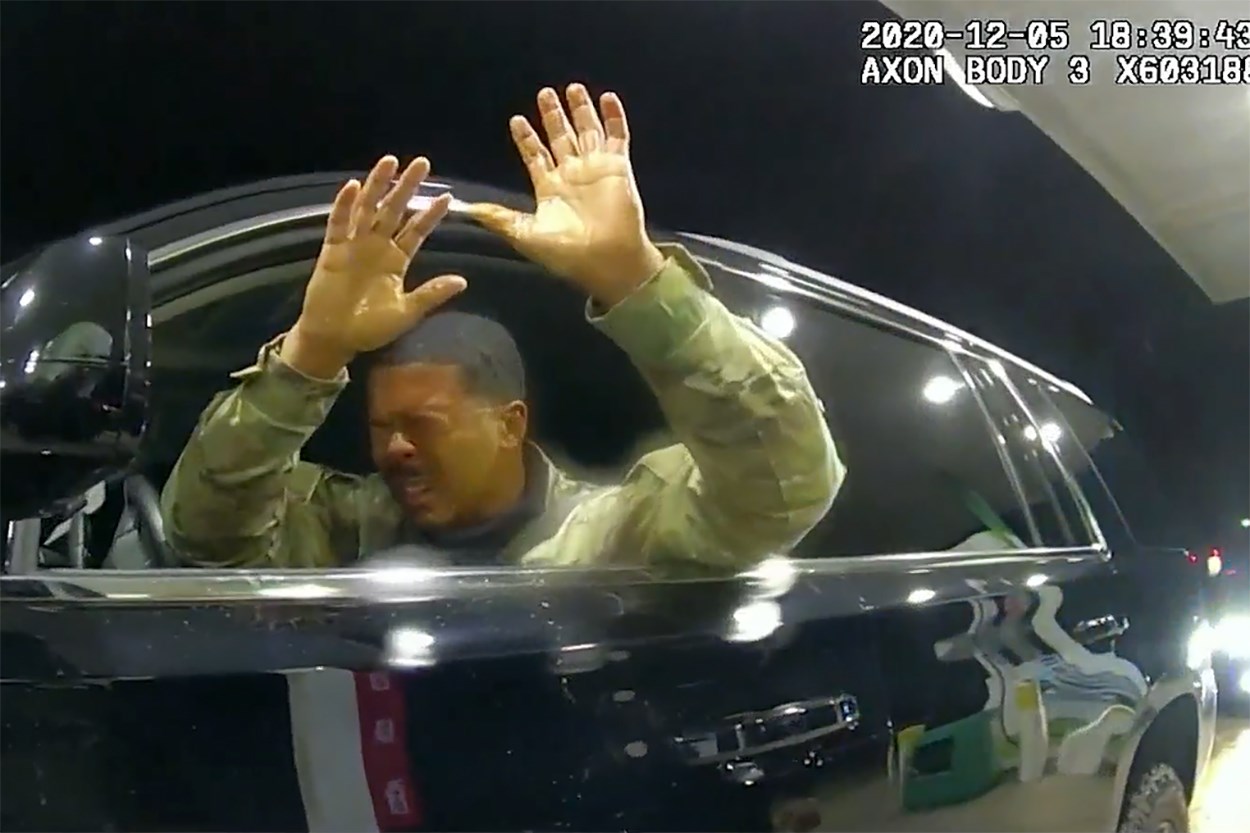
Amid the seemingly endless shootings of men of color by police, it would be easy to dismiss last December’s traffic stop by two Windsor, Virginia police officers as a minor incident – after all, no black people were shot or killed. But it stands out for different reasons. The motorist brutalized by one of the police officers wasn’t a kid, a drug addict, or a person of interest to the police for any reason. Caron Nazario is a second lieutenant in the U. S. Army Medical Corps who was returning from work in uniform with his dog on the back seat. He was stopped for driving his new SUV without a license plate, because the car dealer had taped his temporary plate to the back window and neither of the cops noticed it.

A simple misunderstanding, right? And it would have been if, for example, the driver had been a pretty blonde woman or a white man in a business suit. Instead, despite visible and audible attempts by Lt. Nazario to respectfully de-escalate the situation, he and his dog were pepper sprayed four times while he sat with his hands out the window in plain sight, strapped into his seat. As we see and hear in bodycam videos, the officer who over-reacted was angry because Nazario refused to leave his vehicle with guns pointed at him until someone told him why he had been pulled over. The officer was fired after Virginia Governor Northam and the Windsor police chief initiated an internal investigation. Lt. Nazario has filed a law suit against the officers involved.

Compared to the cases of George Floyd and Daunte Wright, that almost sounds like justice, but it’s not. When I read about this incident, I was watching a celebration of Jackie Robinson Day, which commemorates Robinson’s first game as a Brooklyn Dodger on April 15, 1947.  I was only four on that day, but over the next few years I saw Robinson play at Ebbets Field and learned about what life was like for a Negro hero in post-war America. Like Nazario, Robinson had been a second lieutenant in the Army during the war, though he had to overcome discrimination in the segregated Army to be accepted into Officer Candidate School. And despite a spotless record as an officer, he was court-martialed for refusing to move to the back of a bus in Texas. Although an all-white panel of judges acquitted him, that ended his military career.

What Robinson, and seventy-three years later, Nazario deal with every day of their lives was brilliantly portrayed in the film, 42. In a powerful scene, Harrison Ford (as Dodger General Manager Branch Rickey) tells Chadwick Boseman (Robinson) why the Dodgers selected him from dozens of Negro ballplayers to break the color line. He explains that there were many candidates as talented as Robinson, but Robinson’s history of self-restraint in the face of bigotry and discrimination were what set him apart. Rickey told Robinson that he could only be successful if he never fought back no matter how he was treated.

Three quarters of a century later, the message for every non-white citizen who is involved in a police incident is the same. Remain docile and subservient, follow all instructions instantly, and be respectful no matter what they throw at you. In the cases of Floyd and Wright, even that wasn’t enough to save their lives, which explains why Lt. Nazario drove to a well-lighted gas station before stopping his vehicle.

Like the racists who threw obscenities at Robinson in the media and on the field, it’s clear from the bodycam videos in the Nazario case that the officers who assaulted and tortured Nazario (and his innocent dog) with pepper spray, did not consider Nazario someone worthy of basic human rights. They treated a U. S. Army officer who had done nothing wrong like a piece of trash, and clearly felt entitled to do so.

I  have no illusions about how prevalent that kind of behavior has always been in many police departments. Still, the recent wave of such incidents makes me believe this is yet another piece of the sad legacy left by Donald Trump. It’s almost as if his violent, divisive rhetoric was interpreted as permission to behave that way openly, much like inciting the crowds last December and January was heard by right wing extremists as an invitation to come out of the closet and bring their weapons to Capitol Hill.

The worst part of this may be the innocent victims we fail to notice. The police who care, who do their jobs faithfully and protect the rest of us from harm suffer whenever something like this happens. They deserve our respect and admiration. I make it a point to thank every police officer I meet for being there.

Posted in Articles | 2 Comments