Wrongheaded Leadership

Alan Zendell, April 16, 2020

There is much about the COVID-19 pandemic that defies reason and makes us feel like the world is spinning out of control. That’s serious because in a crisis, one of the things we most need is to believe that we are in control of our fate. At such times, most people look to experts for reassurance and a sense of what the future holds.

In the case of the current pandemic, those experts are medical professionals, statistical modelers, and economists. There are literally thousands of such people working around the clock to get a handle on the virus and its impact. While they don’t all agree, each study or analysis, the forecasts of the various models, and the conclusions of researchers narrows the scope of our uncertainty. No one can tell us with confidence how or how fast the virus spreads, which drugs can be used to treat it, or how long it will be before we have a vaccine.

Every week we learn more, as scientists, mathematicians, and front line medical professionals discard bad ideas and failed experiments using sound research and analysis. The good news is that all of their findings point in the same direction. The only way to control the spread of COVID-19 until there is a vaccine available for everyone is distancing for those who are not infected and isolation for those who are. But despite the nearly unanimous consensus of the people we should be listening to, there remains an almost unfathomable disconnect among our leaders.

The debate between people who worry that a declining economy must be fixed to avoid a catastrophe like the Great Depression and those who believe that our first priority should be saving lives and averting the collapse of our health care system is legitimate. Both are serious issues that must be dealt with. The disconnect occurs when raw politics rears its ugly head.

It’s difficult enough to formulate policies when the only objectives are protecting the lives and health of our people, and preventing economic disaster. Politics corrupts the process, because its goals are narrow, venal, and selfish. There are many people with the financial means to do so who are all too willing to pounce like predators on a system struggling to survive for their own benefit. In normal times we refer to them in benign terms like “special interests.” In times like the ones in which we’re currently living, we call them what they really are – vultures who will do whatever is necessary to achieve their ends without regard for anyone else.

The only way we can protect ourselves from them is with integrity of purpose and strong, effective central leadership. That means President Trump. While many aspects of the fight against the pandemic are difficult to understand, Trump’s failures are not. The problem with his lack of leadership is what most of us who were distressed by his election worried about from the start. His extreme narcissism impedes his ability to feel compassion. Compassion means sensitivity to other people’s pain, suffering, and loss, completely separate from our individual desires and needs. Even many of Trump’s political allies acknowledge that he lacks that quality.

That’s why when people like Anthony Fauci and Deborah Birx explain the reality of the virus to him, he virtually has to be beaten over the head to understand the human impact of getting back to business as usual prematurely. He is always the last person on board with sound policy decisions, and at every critical point his delays worsen the situation. His focus on himself and his need for adoration are always at the forefront, whether it’s claiming credit for everything, worrying about his television ratings, or desperately deflecting blame to everyone else. It’s also the reason that when governors, mayors, epidemiologists, and the people trying to save lives with inadequate supplies and equipment disagree with him, he demonizes them and complains that the mythical deep state is still out to get him.

Trump’s approach to managing the pandemic is entirely wrongheaded. And despite the feedback he’s getting from business leaders that massive nationwide testing must precede ending distancing restrictions, it’s made worse when sycophants and other politicians like Florida Governor Ron deSantis, who are beholden to him for campaign funds, bolster his wrongness. It’s why conservative super-PACs like the Liberty Project have endorsed Joe Biden, arguing that Trump must be defeated in November for the good of the nation.

His other flaws aside, Trump simply cannot be depended on in a crisis, not because he’s evil, but because he is incapable. It’s never been clearer that he lacks the tools and qualities necessary for leadership.

Posted in Articles | Tagged , , , , , , , , , , , , , , , , , | 1 Comment

The Tenth Amendment

Alan Zendell, April 14, 2020

Yesterday, in the midst of an internationally televised pandemic briefing, which was actually more of a tantrum/meltdown that was as embarrassing as it was lacking in facts, President Donald Trump declared that, “The President calls the shots,” and that he has complete authority to order states to resume business as usual whenever he sees fit. He must be taking his cues from Vladimir Putin and Xi Jinping again, trapped in an alternate reality in which the American president has unlimited power. The problem with those assertions is that thing we call the Constitution, which most Americans take seriously, but which Trump regularly ignores and disdains.

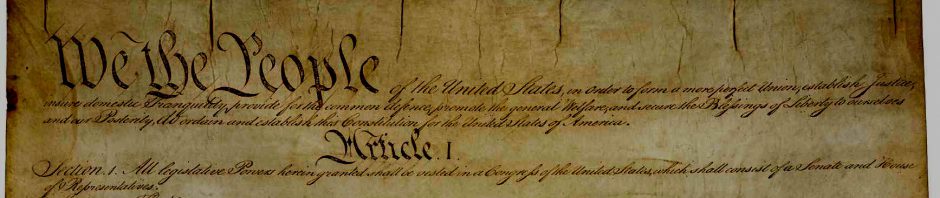
I spent several years interpreting federal statutes and regulations, lamenting at their often obscure, difficult to decipher wording. The Constitution, however, is quite clear and direct on most issues. One of the clearest, easiest to read sections is Amendment 10 of the Bill of Rights:

The powers not delegated to the United States by the Constitution, nor prohibited by it to the States, are reserved to the States respectively, or to the people.

It looks pretty simple to me. The “United States” in this context means the federal government, which could imply the Congress or the President, or both. But what is crystal clear is the distinction between the authority of the President and State Governors. That’s not to say that clever attorneys won’t spend months attempting to argue alternate interpretations before various courts, but let’s be serious. The two most central and contentious subjects addressed by the Founders in our Constitution were distinguishing between a monarchy and a republic, (that is, between a king and an elected president,) and drawing a clear line of separation of powers between the federal government and the individual states.

The State Compacts that were recently announced to assure an orderly return to business as usual when the coronavirus has receded to safe levels, strengthened today by the addition of Massachusetts’ Republican governor, are an unsubtle gauntlet that challenges the President’s authority to force his will on them. When asked how he would respond if the President ordered him to suspend pandemic related restrictions, New York Governor Andrew Cuomo said that if he thought the order endangered his citizens he would refuse it. There’s little doubt that every governor in the compacts, as well as those in other states currently seeing spikes in their coronavirus caseloads (Michigan, Illinois, Ohio, and Louisiana to name a few) would all defy such a presidential order.

I turned to the Constitution Center for a better understanding of the Tenth Amendment. Their analysis points out that the original 1788 version of the Constitution did not contain a bill of rights because the drafters voted unanimously that it was unnecessary. There was a tacit understanding that the federal government was authorized to execute only the powers it was explicitly granted by Article 2, which makes the President Commander in Chief of the Armed Forces but grants him or her no policy-making authority that would supersede the power of either the Congress or the individual States. That’s in direct opposition to the position consistently asserted by President Trump, namely, that he is entitled to do anything not expressly forbidden by the Constitution. That’s like the difference between “innocent until proven guilty” and “guilty until proven innocent.”

There is no doubt that if Trump attempts to force a relaxation of public health guidelines at a time when the majority of governors believe that would threaten the health and lives of their people, they will defy and ignore him. While I would heartily applaud that decision, the notion left me imagining months of constant legal wrangling that would ultimately be decided by the Supreme Court, all occurring while Rome burned, as it were. Since my legal expertise ends with the ability to parse the simple phrasing of the Tenth Amendment I appealed to someone with an incisive understanding of the Constitution.

Ninety minutes later, I understood the reality that that cannot happen, because the President simply has no legal authority to usurp the Governors’ rights to manage their states. There is no statute or phrase embedded in the Constitution that would support such an action; moreover, the President has no enforcement mechanism at his disposal. He has no jurisdiction over local law enforcement, or even the National Guards which report only to their States’ Governors.

Thus, Trump can rant and threaten, but in the end all it will amount to is bluster. We should all be thankful that we are safe from his quixotic temperament, at least in regard to staying safe from COVID-19. Our safety is in the hands of our State Governors.

Posted in Articles | Tagged , , , , , , , , , , , , , , , | 2 Comments

Who’s in Charge? Our Governors.

Alan Zendell, April 13, 2020

Our country and the world are in the midst of a deadly pandemic. If this were a movie, serious actors would portray serious politicians consulting even more serious experts and pooling their resources. Politics would be but a sidebar. Even the most imaginative Hollywood producers couldn’t envision the sort of chaos and leadership vacuum we see in the United States today.

In times of national crisis we reflexively turn to our president for direction, reassurance, and comfort. We do that because of the examples of the past; FDR shepherding us through the Depression and World War 2, Winston Churchill taking the Battle of Britain on his shoulders, Dwight Eisenhower assuring us that we would not be obliterated by Soviet H-bombs, George W. Bush calming us after nine-eleven, Barrack Obama inheriting the worst financial crisis since Black Friday, 1929 and taking the helm with eloquent calm assurance.

Americans need that today, but instead we have a self-aggrandizing president who brags about his television ratings and his popularity on Facebook, who babbles incoherently, misstating facts, inventing falsehoods on the fly, and constantly being discreetly corrected by the experts who should be conducting the briefings in the first place. And Congress? After a rare show of bipartisanship no matter how reluctantly they were dragged into it by the need to assure Americans that they would be able feed their families, they are once again mired in impasse, separated by competing special interests trying to protect their wealth and power.

Trump’s daily briefing ratings are high in the same way that people are fascinated by train wrecks and zombie films. They are longer and less informative every day, with Trump devouring airtime in pursuit of re-election, telling us he’s doing a perfect job, deflecting blame for the mistakes he has made, and spouting insane, debunked conspiracy theories. His public health task force stands behind him for two hours cringing as he undermines their attempts to save lives.

Trump claims he’s facing the most difficult decision of his presidency. That’s true, but the decision is not a binary choice between the health and safety of Americans and protecting the economy. In the 1930s our economy survived a devastating Depression that lasted more than ten years. Yet both it and the Americans who suffered through it recovered rapidly to become the economic and manufacturing behemoth that saved the world in the 40s. Trump’s agonizing decision isn’t about the economy. He’s gambling the lives and health of Americans against protecting short term corporate profits to preserve his re-election chances.

Thank God there’s another source of leadership filling the breach – our governors and mayors. Instead of letting cable networks shape your thinking, check out the daily briefings of our forward-looking governors. There are several every day on television and online: Andrew Cuomo in New York, Gavin Newsom in California, Phil Murphy in New Jersey, Larry Hogan in Maryland, Andy Beshear in Kentucky, Mike DeWine in Ohio, Gretchen Witmer in Michigan…and more.

Each has its own issues and timelines, but they have things in common that you’ll never see in a Trump briefing. There’s no grandstanding or competing for credit and accolades, bragging about false accomplishments or playing the blame game. What you’ll see consistently from these natural leaders is compassion, truth, unifying assurance, and strength. I regularly listen, and I hear no partisanship or buck-passing, no threats to people who voice disagreement, and a willingness to hear and respond to questions no matter who asks them.

As Trump continues living his own reality, trying to force the country into prematurely “re-opening for business” and undermining all the mitigation steps that we’ve taken, (and might have taken many weeks earlier if someone had been able to muzzle him,) we should be thankful for our governors. Realizing they cannot depend on the federal government for anything but misdirection and chaos, they are forming their own coalitions. The east coast compact is New York, New Jersey, Pennsylvania, Connecticut, Delaware, and Rhode Island. The west’s is California, Oregon, and Washington.

The compacts will devise regional approaches to loosening restrictions on businesses and social distancing that reflect local conditions. Both will have priorities uncontaminated by politics or self-interest. Number one will be protecting the lives and health of Americans. Two will be restoring functioning local economies to assure maintenance of food supplies and the financial survival of both families and businesses.

They’re prepared to defy and ignore the President if need be. They know that in the end, the federal government will have to get in line and follow suit. Whether they work in Congress or the White House, they have no choice. There’s an election in November, and the voters are watching.

Posted in Articles | Tagged , , , , , , , , , , , , , , | 3 Comments

Emergency Powers and the Election

Alan Zendell, April 10, 2020

Much has been written about Donald Trump’s leadership or lack of it during the COVID-19 pandemic. But as has been the case throughout this administration, we must be careful not to get distracted and miss a more general menace. In coming months the most serious threat we face may be to our basic freedoms.

From the outset, the President has disdained anything that limited his personal power, and he continues to do so during the pandemic. He has effectively purged his administration of anyone who disagreed with him or tried to limit his sphere of action until, much like Richard Nixon in the waning months of his presidency, he is surrounded by yes-people. He recently removed two Inspectors General who in the course of fulfilling their statutory obligations, rendered decisions inconvenient to Trump. Most recently, he nullified the provision of the $2.2 trillion stimulus law that required independent oversight of a $500 billion relief fund, stating clearly that he intended to ignore that provision.

We’re entering a time when Trump’s lack of respect for law and the Constitution may be the most important issue we face. A few weeks after his inauguration, I posted an article titled: ”Is it Fair to Compare Trump’s Rise to Power with Hitler’s?” It was relevant then, and still is. I did not suggest that Trump intended to lock his enemies away in concentration camps and gas them. I (and many others) examined the ruthlessly efficient manner with which Adolf Hitler dismantled the Weimar Republic’s Constitution and replaced it with one of the vilest tyrannies in modern history.

Specifically, I addressed the striking similarities between Trump’s style of politics and leadership, and Hitler’s. The comparisons were easy: extreme populism, scapegoating of targeted minorities, contempt for the legislature, attacks on the press and judiciary, and zero tolerance for disagreement and dissent. They remain valid today as nothing in Trump’s demeanor or actions has changed.

Hitler solidified his personal power by using emergency declarations to force the Reichstag (parliament) to grant him virtually complete supremacy for the duration of the perceived crises. Hitler never relinquished that power. The issue became relevant this week when the U. S. Supreme Court upheld Texas Governor Greg Abbott’s suspension of abortion services for the duration of the pandemic, ostensibly to conserve medical resources for COVID-19 patients. The Court based its decision on Jennings vs Massachusetts, a 1905 case in which a private citizen challenged the right of the city of Cambridge, Massachusetts to fine him for refusing a smallpox vaccination.

The issue was when the State (in that case Massachusetts, but the concept applies to the federal government as well) has the right to restrict the liberty of a citizen to protect the health of the general public. To understand the implications of Jennings vs Massachusetts in the context of COVID-19, I turned to a study by the National Center for Biotechnology Information in the National Institutes of Health.

According to the study, ‘the Court recognized that some aspects of liberty … which were deemed “fundamental,” were subjected to the “strict scrutiny” test: the Court determined (1) whether the government could prove that challenged law served a purpose so “compelling” that it was justified in taking action and (2) whether what the law required or forbade was “narrowly tailored” to achieve that purpose and did so with as little interference with individual liberty as possible.’ That is of great interest now, because the Court went on to specify that voting was a fundamental liberty.

There is currently much controversy over the general applicability of Jennings vs Massachusetts to our current health emergency, particularly with respect to the coming election.  We saw the first shot in that skirmish fired last week in Wisconsin, when Governor Evers attempted to postpone the presidential primary to avoid violating social distancing rules, but was overruled by the Supreme Court in a clearly partisan decision. We’ve seen more disturbing evidence of what is likely to occur in coming months as the President declared war on House proposals to allow only mail-in voting so the election is not affected by public health concerns.

Many people fear that Trump will be unconstrained in his attempt to consolidate and retain power. Will he try to use emergency powers to influence, postpone, or cancel the election? I believe without fear of exaggeration that this is a pivotal moment in our history. It’s no time to get lost in the weeds. If there was ever a time to be vigilant, it’s now.

Posted in Articles | Tagged , , , , , , , , , , , , , , | 1 Comment

Voting in the Time of a Pandemic

Alan Zendell, April 7, 2020

Since becoming president, Donald Trump has in some ways been remarkably consistent. He has thumbed his nose at the rule of law and ignored the Constitution. He has attempted to nullify Congress’ oversight obligation and attacked every federal judge who declared one of his executive actions unconstitutional. He bristles at any suggestion that anyone has the right to hold him accountable.

In more subtle ways, he couldn’t be more inconsistent. He postures like a high stakes poker player, holding his cards close to his vest, lying, exaggerating, and contradicting himself, while claiming to have the most transparent administration in history. The master of insult and artless vulgarity knows no bounds when attacking people who disagree with him; yet, in recent weeks, in the heart of the coronavirus pandemic, he told Governors that if they didn’t treat him nicely, he wouldn’t talk to them. And he accuses every journalist who asks questions that challenge his decisions or address his misstatements of being nasty and not doing their jobs.

Trump is most inconsistent in the matter of state versus federal responsibility and authority. The most contentious issue in the early days of our democracy was the debate over the rights of individual states versus the reach of the federal government. This has been a constant issue during the coronavirus pandemic though Trump is neither a states’ rights advocate nor a federalist.  He possesses no political ideology beyond the accumulation of personal power. 

Even ardent Libertarians agree that the Executive has an essential role in the defense of the nation. We generally think of that in military terms, but since the administration decided to take it seriously, last week, it has been describing the fight against the pandemic as a war. Trump refers to the mobilization of resources and personnel as a military operation; yet, while he strutted as the all-knowing master of the situation, he  reneged on his responsibility to individual states, claiming it’s Governors who should be held accountable. (Remember, accountability is the most obscene word in Trump’s limited vocabulary.)

The state Governors have been the pandemic response leaders, as Trump and the federal bureaucracy in general were caught flatfooted and remained weeks behind in every decision. Trump accepted no personal responsibility for assuring that states in crisis, notably New York, but soon to be followed by others, had the resources necessary to protect their citizens. Facing rising demands and opposition, he reluctantly allowed FEMA (which he called useless early in his presidency) and the Army Corps of Engineers to do their jobs and redeployed two Navy hospital ships to help, actions for which he now claims full credit.

The conflict between state and federal authority during the pandemic took a bizarre turn yesterday, when Wisconsin Governor Tony Evers (D) issued an executive order to postpone today’s presidential primary election and extend the deadline for absentee voting. The Republican legislature got the State Supreme Court to stay the decision, and the U. S. Supreme Court ordered the election to occur as scheduled.

The federal court, with Trump appointees in the majority, argued that Evers’ decision would disenfranchise some voters. I have no idea what that means, since forcing thousands of people into close quarters was likely to cause hundreds or thousands of new infections. What is more disenfranchising than being dead?

The Wisconsin decision occurred three weeks after Ohio Governor Mike DeWine (R) took essentially the same action because in-person voting violated CDC and state pandemic guidelines for social distancing. The difference between Ohio and Wisconsin was that Ohio’s Republican legislature supported DeWine’s decision, and when a federal court rejected it, DeWine ordered his Public Health Director to issue an emergency declaration which executed the order, ignoring the judicial decision.

Clearly, the Republican agenda changed since March. On the surface there’s no reason why Republicans care when the Democratic primary is held or who votes in it. Joe Biden looked like a sure winner, and with Bernie Sanders on the verge of conceding the nomination the primary was almost irrelevant. So why take the unusual step of rushing a Supreme Court decision in hours?

The New York Times suggests that the Wisconsin case “stands as a first test case in what both national parties expect to be a protracted fight over changing voter rules to contend with the pandemic…” Many Democrats want Trump to issue an emergency declaration authorizing mail-in voting next November in the event the pandemic still poses a major health threat. Republicans believe that would allow more people to cast ballots, and conventional wisdom says that would benefit Democrats.

If you think COVID-19 has been exciting, wait until the voting rights battle heats up. Don’t let yourself be lulled into apathy after surviving the virus. The fight over the November election could be the greatest threat our democracy has ever faced.

Posted in Articles | Tagged , , , , , , , , , , , , , , | 3 Comments

Lest We Forget . . .

Alan Zendell, April 3, 2020

At a time of crisis with Americans dying at an exponentially increasing rate, I’m torn between possibly worsening our country’s divisiveness and persisting in telling necessary truths. The Trump administration daily makes that choice easier by continuing to shirk its responsibility to manage the COVID-19 pandemic.

House Speaker Nancy Pelosi was the first national figure to say it, and yesterday, the Boston Globe editorial board echoed her: the President is going to have the blood of Americans on his hands. We don’t yet know how many, but if we trust the consensus of epidemiologists and other infectious disease experts, Trump’s deliberate refusal to act for three months may cause up to two million unnecessary deaths.

For three years, Trump’s missteps did not have immediate life and death consequences, although parents of children who died in captivity on our southern border might disagree, and farmers who saw their livelihoods wrecked by Trump’s trade war might feel the same. But as the number of pandemic-related deaths doubles every two or three days, we cannot tolerate lies, alternate facts, or political spin.

The ongoing disconnect between the President and every competent medical expert is unlike anything we’ve seen in a century. Each day wasted without a consistent national approach to mitigating the spread of the virus costs lives; yet, we continue to see Trump having to be dragged kicking and screaming to tell the truth. In an administration in which facts are variable commodities, it’s essential that we document everything, lest people forget in November.

More than half of us questioned Donald Trump’s fitness to lead the country, concerned that someone driven by lust for wealth and power who suffers from a serious narcissistic personality disorder couldn’t be trusted in a crisis. Trump has demonstrated how right we were to be concerned every day since COVID-19 erupted in Wuhan, China. Our intelligence services understood the severity of the problem in Wuhan in December. Trump was informed of the likely consequences more than three months ago. He even bragged last week that he knew there would be a pandemic before anyone else.

But Trump doesn’t like inconvenient truths. He has spent his life in business avoiding them, leaving a trail of lies, litigation, and financial devastation in his wake. His fraudulent populism masks a more important truth. Trump cares about working people, the poor, and the middle class only in terms of capturing their votes. His allegiance is to corporate America and those Americans among the most wealthy who will do anything to preserve their fortunes. When he was told that COVID-19 was likely to come to America and kill millions, his first and only consideration was preventing panic in the financial markets.

The likelihood that millions of Americans could die if he ignored the experts never stood a chance in Trump’s priorities. It was a bothersome abstraction at best for a man who consistently prefers his own uninformed opinions to well established science and experience. Trump hates being told he’s wrong, and the COVID-19 crisis has shown him at his worst. Concern for the lives of the people he swore to defend was never a consideration until the results of his criminal malfeasance started to be felt.

Doctors Fauci and Birx told Trump what we’d face. They explained that if cases doubled every two days there would a thousand times as many in twenty days and a million times as many after forty days. But most people think linearly. Concepts like exponential growth are not intuitive for them. Thus Trump remained focused only on being re-elected, and it was impossible to convince him that action was urgent, if preparing the country was likely to crash the economy.

He thinks of himself as a high-rolling gambler, but there was a lot more at stake this time than failing hotels in Atlantic City. A president who is totally lacking in compassion who considers everyone who disagrees with him an enemy cannot possibly lead in a crisis that requires him to choose between his own self-interest and the nation.

Donald Trump could have handed Dr. Fauci the podium. He could have told the truth and begun averting the worst case in January. According to all the mathematical models, that might have meant the difference between 100,000 and 2,000,000 American deaths. Choices are rarely as black and white as this one, yet he dragged his feet and completely failed to protect the country.

We won’t know how many lives will be lost as a result of Trump’s malfeasance for months. I intend to tell the truth every day, lest we forget when it’s time to hold him accountable on Election Day.

Posted in Articles | Tagged , , , , , , , , , , , , , , | 2 Comments

After Sheltering in Place – What’s Next?

Alan Zendell, March 28, 2020

As one of the more vulnerable senior population, I’ve been thinking about what will happen after the corona virus pandemic runs its course, at least in its initial wave. One of the most challenging aspects of managing a pandemic is a lack of meaningful data. That occurs in two principal ways.

One is that much of what we think we know about the virus comes from past experience with other, similar ones. But as epidemiologists and virologists continually remind us, each virus is unique, and inferring the future behavior of this new one is risky.

There’s been a lot of speculation about a “second wave,” or a seasonal revival of COVID-19 next winter. That’s based on anecdotal evidence from previous epidemics like the Spanish Flu of 1918, in which the second and third waves killed most of the 675,000 Americans who perished from it. That number is huge, but we must keep in mind that medicine has advanced greatly in the last hundred years, and 1918 was the year of our greatest involvement in World War One. Many of our medical professionals were overseas and the constant movement of millions of troops in the United States and Europe made it impossible to slow the spread of the disease.

Will COVID-19 be as deadly? We don’t know. Initial data suggest a far lower fatality rate than the Spanish Flu, but possibly a higher rate of infection without quarantines, sheltering in place, and other distancing measures. That’s extremely significant since our population has more than tripled since 1918, and the population density of our urban centers has increased dramatically. We don’t really know what will happen next season or if COVID-19 will mutate into something either more or less dangerous than itself.

Another source of uncertainty is the number of reported active cases. Our data always lag reality. We won’t have an accurate timeline of how many people were infected until after the pandemic passes. Our country wasted so much valuable time in being able to test large numbers of people, we have no idea how many are infected.

As I write this my television screen tells me that nearly 112,000 Americans have tested positive for the virus. But that number could be low by orders of magnitude. Tens of millions have undoubtedly been exposed by now, but we probably won’t know definitively for years. CDC projections suggest that half our population, more than 160 million people may contract COVID-19. As Bill Gates said earlier this week, the only way to know for certain is to test every American.

Need a reality check? If COVID-19’s fatality rate in the United States is one percent and 160 million people are infected, that implies 1.6 million deaths.

My wife and I are sheltering in place, as directed by our governor. I’m guessing we may have to continue to do so until at least Memorial Day. After that, what will normal look like? Say the spread of the virus is reduced to zero by July. We end social distancing and start interacting with friends and family again. But half the population will already have the virus in their systems – viruses in our bodies never go away, they just become dormant. Will that pose a risk for people who followed the rules and remained virus-free?

Since I’m basically ignorant about everything medical, I consulted with a physician I trust (my daughter-in-law.) She assured me that even if I touch, hug, and kiss people who are still hosting the virus, I won’t catch it from them unless they are actively symptomatic. I have complete confidence in her, but there’s still the caveat that although we know that’s true for other viruses, we won’t be certain about this one until after the fact.

Another thing we discussed was “herd immunity,” which is a designation that is easily misinterpreted. Herd immunity occurs when so many members of a community have weathered the virus and developed individual immunity, there’s no place left for it to spread. From the point of view of people who haven’t been exposed, that means there’s no one left to catch it from. Big sigh of relief number two – except that this conclusion too is based on assuming that COVID-19 behaves the way previous viruses did.

All things considered, all of us elderly folks who continue to follow the rules and shelter in place, limiting the likelihood of exposure for the next few months can be reasonably assured that when life returns to something like normal next summer, we can hug each other without fear of dying. At least until the anticipated second wave hits, but I’m confident we’ll have a vaccine by then.

No one knows for sure, but life always has its uncertainties.

Posted in Articles | Tagged , , , , , , , , , , , , , , | Leave a comment

The Coronavirus War – Trump Against Everyone Else

Alan Zendell, March 27, 2020

The most remarkable aspect of the coronavirus crisis is President Trump’s refusal to accept the reality of the pandemic. We’ve seen his character and leadership flaws since the day he took office. We’ve shaken our heads over his narcissism and lack of compassion, his self-absorption to the detriment of the welfare of the American people.

We probably shouldn’t be surprised. This is the president who twisted the arms of senators in his own party to pass a health care bill that would have deprived twenty-five million low income Americans of insurance coverage. He is the president who labeled poverty-stricken central American refugees seeking a safe haven for their families murders and drug dealers, and then directed his Border Patrol Agents to incarcerate their children in cages.

When good things happen, Trump is the first to claim credit, even when he had little or nothing to do with them. When something terrible happens, rather than showing compassion and support for those who are negatively impacted he deflects responsibility and looks for others to blame, lest his image be tarnished. He disdains science and ignores the expert advice of people in his administration, preferring is own ignorant opinions, on every subject from climate change to environmental health to foreign policy.

All that was disturbing and potentially dangerous each time it happened, but until now it hasn’t represented an imminent existential threat to millions of people. When Trump was elected, we all hoped and many prayed that he would grow into the job. He hasn’t. He is as petty and vicious, as ego driven and lustful for power, as lacking in decency and morality as those of us who followed his career for decades knew he was.

For three years, we sucked it up and counted the days until the Trump nightmare was over. But now, the unthinkable has happened. The world and our nation face a crisis that could kill millions and forever change the fabric of our society. For the first time since he was elected the physical and economic health of the entire nation require Trump to show leadership and put aside his self-interest. To date he has failed utterly at both.

On virtually every important issue, we’ve seen Trump misrepresent and lie about everything that displeases him. He goes back and forth, bending with whichever wind batters him most strongly, contradicting himself and changing positions daily. Thus it has been since the first day of the coronavirus pandemic.

For months, he refused to take it seriously. First it was China’s problem. Regardless of the fact that people like Drs. Anthony Fauci and Deborah Birx recognized the threat immediately, Trump simply couldn’t tolerate the universe daring to upset his plans for re-election. Rather than accept the reality that bombarded him from every knowledgeable, competent adviser, he gambled on his hunch that it would all blow over.

Most of us now know that measures like quarantine, isolation, and social distancing could have slowed the virus to a manageable level if they had been initiated in time. The fact that China dropped the ball initially enabled the virus to spread beyond its borders, but there was still time. Epidemiologists and infectious disease specialists knew in January that a full court press was needed to avoid death and suffering for millions; every day wasted getting started would cost lives. But declaring an emergency might have panicked both the general population and the financial markets, and either might have doomed Trump’s re-election.

Instead of acting, Trump and his minions fostered the notion that the pandemic was a media hoax. The American media must be damn powerful to influence the World Health Organization and the overwhelming mass of medical professionals throughout the world. Even with evidence from China, Hong Kong, South Korea, and Italy before him, Trump failed to act, and now there are more confirmed cases in the United States than anywhere else in the world.

Trump accepts no responsibility for that. He tells us every day that his administration is doing a perfect job. As death counts rise in Washington State and New York, and the exponential growth curve of infection and death follow the same pattern in New Jersey, California, Florida, Louisiana, and Michigan, Trump now blames their governors for failing to prepare.

Governors Andrew Cuomo of New York, Jay Inslee of Washington, and Gretchen Whitmer of Michigan relied on health professionals and proven mathematical models to anticipate the need for masks, protective gear, ventilators, and hospital beds. But the Great Oracle Trump knows better. Today he accused them of grossly exaggerating their needs, because the numbers he pulls out of his ass say they’re wrong.

I wonder who he’ll blame when our death toll reaches one million.

Posted in Articles | Tagged , , , , , , , , , , , , , , , , , , , , | Leave a comment

A Tale of Two Governors

Alan Zendell, March 26, 2020

Do events create heroes or are heroes always with us, emerging as leaders when circumstances require them? Self-proclaimed hero, Donald Trump, believes he is uniquely qualified to lead our country in all things. But as we have repeatedly seen during his administration, declaring oneself a leader is a far cry from being one.

The coronavirus pandemic shined a blinding light on this basic truth. At a time when our nation is desperate for effective leadership, Trump continues to focus primarily on what is good for Donald Trump. He cares about minimizing the effects of the pandemic not in terms of saving lives and reducing the suffering of individuals and families, but by limiting the damage to his re-election campaign.

White House leadership in attacking the pandemic lagged for months because honesty and transparency about the likely spread of the virus would have had an inconvenient effect on financial markets, which Trump relies on to keep his base happy. Even after wasted weeks which could have been used to ramp up the nation’s preparedness and blunt the rate of infection, Trump dispenses confusion and misinformation on a daily basis. Every time he briefs us about the effects of the virus, the nation’s preeminent expert on infectious disease, Dr. Anthony Fauci has to correct and contradict him to prevent him from undermining the efforts of the medical community.

We owe a huge debt to the state Governors who have been on top of this crisis since Day One, who eschew self-praise and simply inform, support, and inspire confidence in their citizens.  Several have stepped up and filled the breach, but I’d like to focus on Andrew Cuomo of New York and Andy Beshear of Kentucky.

Cuomo is one of those heroes who has been with us for decades who rose to the challenge as soon as the threat of the virus was realized. Partly as a result of circumstances, as New York State’s cases are spiking ahead of other states’, Americans have watched Cuomo talking to New Yorkers every morning. He focuses on providing information, explaining why his directives are necessary to protect the health and lives. He speaks directly to the people, easily, casually, openly, honestly. There is no ego, no self-aggrandizement, no confusion – in a word no bullshit. He never disparages the president, but he underlines Trump’s inadequacy as a leader every day just by being himself.

Many people in New York now refer to their governor as “President Cuomo,” because he calms them and demonstrates an unwavering focus the needs of his people, while they see exactly the opposite from Trump. And it’s not just New Yorkers. I watch him every morning inspired by his self-effacing truth and courage. At a time of anxiety and insecurity, confronting perhaps the most serious threat our country has ever faced, he convinces me every day that some politicians can rise above petty self-interest and partisanship. His constituents love him with good reason.

A year ago, if you didn’t live in Kentucky, you probably never heard of Andy Beshear. Running for governor in the reddest of states that voted for Trump by nearly two to one in 2016, he was given little chance of defeating incumbent Matt Bevin, an ardent Trump supporter,  which in Kentucky, should have assured his re-election. But his Trump-like attitudes and his repeated attacks on teachers and other state workers, made him vulnerable, should a true leader of the people emerge.

That leader was Andy Beshear, another latent hero who rose to the challenge, who while Kentucky Secretary of State, went to court to prevent Bevins from wrecking the teachers’ retirement system. In doing so he inspired teachers and parents who valued education, without whom he couldn’t have won.  His victory over Bevin stunned the Kentucky Republican establishment.

Beshear is the best kind of populist. His message is unity over divisiveness, concern for people over politics. His daily briefings on the coronavirus don’t receive the national exposure that Cuomo’s do, but his message is the same: honest, caring, inspirational. “There is no ego in any of this…no Democrat or Republican…only us as Americans versus the Coronavirus.” He is revered by red-state Kentuckians, receiving praise from all over the political spectrum and recognized as the kind of natural leader we need in times of crisis.

Memes depicting offers from other states wanting to swap their local treasures for him are going viral all over the internet. My own state, Maryland, offered Pimlico, Cal Ripken, and a bushel of Maryland crabs, the very soul of our state in exchange for Beshear, and we already have an effective governor in Larry Hogan.

Thank God for governors like Cuomo and Beshear. At a time, even before the coronavirus pandemic, when our political system seems in jeopardy of self-destructing from partisanship and divisiveness, they give us hope for the future.

Posted in Articles | Tagged , , , , , , , , , , , , | Leave a comment

The Price of a Grandparent’s Life

Alan Zendell, March 24, 2020

Partisan politics is always suspended during a national emergency, isn’t it? We didn’t hear much partisan bickering on December 8, 1941 or September 12, 2001. Our nation had been attacked, and the vast majority of Americans put aside their differences. Nothing unifies us like surprise attacks that kill thousands of Americans. Until now, apparently.

The Trump administration has raised partisanship and divisiveness to an art form. It is so deeply ingrained in its DNA that it can’t be turned off even as it becomes clear that more than a million lives may lie in the balance. That’s because they see everything through the lens of preserving the wealth of billionaires and the corporations that sustain them. To be sure, there are exceptions, but all of the most divisive issues of the past three years – taxes, universal health care, immigration, to name a few – have a single common denominator: avoiding a massive transfer of wealth from the haves to the have nots.

If you wonder whether this battle knows any limits, I refer you to yesterday’s Fox News interview with Texas Lieutenant Governor Dan Patrick. The interview occurred minutes after President Trump first publicly floated the idea of “loosening” social distancing restrictions so people can go back to work. The looks of horror on the faces of the health care professionals who stand behind him at the podium when he says these things tell us all we need to know. I was shocked, but only for a few seconds, before a light went on.

The elitist extremist faction among Trump’s advisers haven’t let up at all. For days we’d already seen the Senate locked in a partisan impasse over a two trillion dollar bailout bill. The divide was clear. Democrats wanted the bulk of the money to go directly to displaced workers and their families during the coronavirus crisis, and to assure that everyone afflicted by the virus received treatment free of charge. Republicans argued that saving employers was a higher priority because without them there would be no jobs. We’ve heard that argument repeatedly since Reagan was president.

The battle in the Senate was familiar. We’d seen it play out dozens of times since partisanship rose to its current level with the election of Barrack Obama. But Trump elevated it to an unprecedented level, one that is completely lacking in compassion and moral value. Trump is proposing to triage the lives of Americans, primarily those who are elderly or already compromised, against what he calls “saving the economy.” That is as bald-faced a lie as anything Trump has ever said.

It’s not about saving the economy. It’s about preserving the wealth of what Bernie Sanders refers to as the ruling class. This isn’t about some self-named Socialists stealing their money. It’s about whether that ruling class is willing to sacrifice millions of American lives to preserve their wealth. Trump is proposing to triage the lives of Americans against the disruptions to our economy caused by the need to stop the spread of the virus.

Trump believes human lives can be measured in how many billions of dollars of wealth can be preserved per death. That’s what the Fox interview with Dan Patrick was about. Fox News had been primed for the shift in tone from the White House. Within minutes they, through Lt. Governor Patrick, were pitching the idea that grandparents ought to be willing to sacrifice their lives to preserve the economy for their grandchildren! As if it were a binary choice.

The Great Depression didn’t destroy our economy. Franklin Roosevelt didn’t worry about whether the economy would fall apart when millions of Americans were hopeless and starving. Our economy is not the stock market. It’s farms and factories and trucks and human labor. Trump trying to convince his base that taking steps that could increase the number of virus-related deaths by millions is a fair price to pay so that corporations don’t lose money is criminal malfeasance, as vile as the holocaust in its own way.

Fox News asked Patrick what he thought of Trump’s idea. Patrick said, “if that’s the exchange, I’m all in. I just think there are lots of grandparents out there in this country like me.” Really? He thinks millions of grandparents are willing to volunteer to die of the virus, or that their families would be willing to sacrifice them?

Even without compassion, the truth is that millions of dead Americans would be far more devastating to our economy than crashing financial markets. Another truth is that Trump knows his incompetent response to the virus since January has placed his re-election in jeopardy. He has no other priority.

By the way – Trump is a grandparent, too.

Posted in Articles | Tagged , , , , , , , , , , , , | Leave a comment