Who’s in Charge in the West Wing?

Alan Zendell, February 28, 2018

Among all the difficult jobs in the world, I’d have thought being the Marine General in charge of the U. S. Southern Command after two command combat roles in Iraq would rank pretty high. Who’d have imagined they were a piece of cake compared to managing the staff in the West Wing of the White House? When you consider that the staff contains both the president’s daughter Ivanka and her husband, Jared Kushner, the idea doesn’t seem so far fetched.

In Kelly’s former jobs the word “command” had a clear definition. People either did their jobs properly and followed the general’s rules and protocols or they were removed. Everyone working for him understood that clearly. What senior military officer would accept a critical command assignment without that virtually absolute authority?

Remember when Kelly accepted the position of Chief of the White House staff? That was back in the days when Steve Bannon had constant access to the president and people like Sebastian Gorka, a right-wing extremist with questionable credentials and an outstanding arrest warrant in Hungary was advising him on terrorism and Islam. Kelly cleaned that mess up quickly, but that was easy compared to keeping a lid on the president’s erratic behavior and temper tantrums.

It was also a lot easier than managing Ivanka and Jared, who knew that daddy would always be there for them no matter what. The reports of Kelly’s disdain for both are too numerous and from too many different sources to be discounted. He has mocked Ivanka as a girl playing government, and his long-simmering mini-war with Kushner came to a head last week when Trump publicly stated that he was delegating all decisions on security clearance to Kelly, and that he was “sure he’d do the right thing.”

That’s exactly what Kelly did. He stripped Kushner’s Top Secret clearance, reportedly along with the clearances of 130 other staffers who had been handling sensitive information on interim clearances for more than a year. All this on the heels of credible reports that four foreign nations, all of which appear in Kushner’s portfolio of responsibilities, have been discussing how to use his inexperience and financial vulnerabilities to leverage policy with the president. And two of those countries, Israel and the United Arab Emirates, are pivotal to Kushner’s efforts to reach Middle East peace accords.

Rumors continue to fly about Kelly’s tenure in the White House. Trump really can’t fire him any more than he can fire Attorney General Jeff Sessions, Deputy Attorney General Rod Rosenstein, or Special Counsel Robert Mueller without bringing down a firestorm of criticism on an administration whose credibility has already been stretched as far as it can be. So Kelly’s future in the West Wing is in his own hands. How long will he be willing to put up with the Trump Family White House?

Kelly’s present lack of command authority isn’t unique to him. When NSA Director, Admiral Mike Rogers was interviewed yesterday by the Senate Intelligence Committee, he revealed that while cyber threats from Russia and elsewhere continue to expand, and his people have the ability to counter them at their sources, he has not been given the authority to act by the president. His frustration as he revealed than on national TV, was evident.

And then there’s the situation surrounding National Security Advisor H.  R. McMaster. He publicly agreed with the findings of every law enforcement and security agency that confirmed Russian cyber attacks and interference in our elections, only to be contradicted by the president the next day because of his baseless refusal to accept reality. That makes three senior military advisers of unquestioned stature and ability who were appointed by this president, who’ve been emasculated by that same president who is totally out of his depth on matters of security.

It seems that our president still has not figured out that the White House is not his own private company. In the past when his shoot-from-the-hip approach to business got him in trouble he simply filed for bankruptcy, fired everyone he could, and took off leaving a pile of debris in his wake. Have you been to Atlantic City, New Jersey recently?

Governing the United States of America doesn’t work that way. The level of chaos that exists in this administration is unprecedented, and there’s a lot more at stake than Trump’s real estate empire. Physical objects that do not have a strong center of gravity can be toppled by a stiff breeze. The Trump administration is the political analog of such an object, a collection of people all traveling in different orbits with no apparent cohesion, the classic definition of a house of cards.
Posted in Articles | Tagged , , , , , , , , , , , , , | 1 Comment

Guns In Schools

February 26, 2018

When Governor Jay Inslee of Washington responded to President Trump’s proposal to arm teachers in our public schools at the National Governors’ Conference, it didn’t take a mind reader or a psychologist to read the president’s body language. Governor Inslee talked about his conversations with teachers and law enforcement professionals who are in the main strongly opposed to the idea.

As Inslee spoke, two things were apparent. The president was struggling mightily to control himself, and he deserves to be acknowledged for keeping his temper in check. On the other hand, it was clear that while he was struggling to present the appearance of listening, he dismissed everything the Governor said.

It’s unfortunate that praising the president this way sounds rather lame, as the bar is so low based on his often demonstrated behavior. If he ultimately influences the Congress to pass meaningful legislation that limits the spread of assault weapons and at least to some degree prevents people who shouldn’t own guns from purchasing them, I will praise him without reservation, but as he so often says, we’ll have to wait and see.

I spend a lot of time in a Florida high school as a volunteer math tutor, and I have been there every day since the Parkland massacre. The experience has been especially poignant because there had been a fatal shooting in which a fourteen year old student who attends that school was killed just a few days earlier. So Parkland occurred against a background of grief and trauma counseling that had already been going on for days.

As a volunteer I got to observe a number of things. First, the students themselves seemed to absorb the shock quite well. I was impressed by their calm demeanor through it all. The only sign I picked up on that anything had changed, was that the group of students I interact with suddenly seemed more involved and committed to succeeding. That means they showed up consistently and on time and were more engaged in what we were doing than I’ve ever seen them. Is there a demonstrable cause and effect between that and Parkland? I’m not qualified to say, but I think so.

Perhaps more important, I have not encountered a single teacher, counselor, or administrator who thinks carrying a gun in school is a good idea. They believe that’s the responsibility of law enforcement, and I agree. Of the many reasons I believe that, I will cite two.

The first is an entirely practical matter. Placing the responsibility for protection on school administrators would be extremely costly. Most school systems are already strapped to meet the basic cost of educating students. If we are serious about “hardening” our schools, whatever measures we take should not be at the mercy of budget politics. Further, if each school was responsible for its own security, resources could not be used efficiently.

School security should be a line item in the budget of every police department. It’s no secret that public safety budgets are easier to defend than school budgets when taxes are debated, especially in states like Florida. We should allow people whose business is security to allocate resources in the best possible way.

Budgets aside, any law enforcement professional will tell you that being trained in the use of firearms doesn’t prepare someone for actually firing at another human being with the intent to kill. Could teachers and administrators pull the trigger if they had to under the stress of an attack? Would their training be enough to make them an effective deterrent? Or would they just get themselves killed and possibly endanger others?

It’s easy for people like the president to make proclamations. I have no idea whether he’s ever fired a gun or whether he understands the first thing about the use of firearms. As far as his public persona goes, the only form of violence he seems to grasp is verbal bullying and legal litigation.

When he said earlier today that he would have personally stormed the school even if he’d been unarmed, comparing himself to the deputies that failed to enter the school, he reached a new high in disingenuous rhetoric. This is the same president who continues to claim that John McCain was not a hero because he was in a POW camp, and he’s the same man who pulled every string imaginable at God knows what cost to avoid serving in the armed forces.

When I hear him say things like that I think, your base may love the tough guy talk, but the rest of us understand it for what it is. As the Parkland students might have said, it’s pure BS.

Posted in Articles | Tagged , , , , , , , , , , , , , , , | 3 Comments

Rob Porter’s Security Nonclearance

Alan Zendell, February 10, 2018

Sherlock Holmes (aka, Sir Arthur Conan Doyle) famously said, “…when you have eliminated the impossible, whatever remains, however improbable, must be the truth.” Consider the sordid case of Rob Porter’s temporary security clearance.

It’s impossible that while the FBI has been aware of the very credible allegations of spousal (and now girlfriend) abuse for more than a year, no one on the White House Staff found out until this week. It’s impossible that Chief of Staff John Kelly, given his well-known concern for order and security would not have wondered why the FBI hadn’t granted Rob Porter a security clearance in over a year. It’s also impossible that General Kelly wouldn’t have been seriously concerned about that considering Porter’s daily access to highly sensitive information.

Holmes would have approached the issue logically. Members of the White House staff were surely aware of Porter’s checkered past. John Kelly had to have demanded an explanation of the delay in granting him clearance. Kelly understands as well as anyone that if Porter was guilty of the things three women accused him of, he would have been a likely target for blackmail. All his instincts about security would have been setting off alarm bells in his head, yet he not only did not restrict Porter’s access to secret documents, he encouraged him to stand by his denials. And he allowed Hope Hicks, a woman who was romantically involved with Porter to frame the White House’s defense of him to the media.

Holmes would have been certain that was all true, but he wouldn’t have let the matter rest until he understood why Kelly acted as he did and the FBI has allowed Porter’s temporary clearance to stand so long, and we shouldn’t either. Every American should be extremely concerned about the circumstances that would cause someone like Kelly to look the other way. It’s certainly not what we’d expect of a four-star general.

One theory is that he simply liked Porter. Jennifer Willoughby, his second ex-wife, even while describing the bone-chilling details of their abusive marriage, described Porter as smart, personable, and competent – in his work life. She wasn’t surprised that he got on so well at work because no one there saw the other side of his personality. She said he was completely different at home, a very troubled man who was unable to control his flashes of anger in an intimate relationship.

I believe that, but I have to ask, in the highly stressful environment of the West Wing, which if one tenth of what Michael Wolff wrote is true, was an emotional pressure cooker, wouldn’t a man like General Kelly who is supposed to be an expert at assessing his subordinates have noticed something? Surely someone as troubled as Porter apparently is who cannot control his anger and frustration with people he loves would have revealed some aspect of that to the Chief of Staff who heavily relied on him.

Should we believe Deputy Press Secretary Raj Shah’s contention that until the photographs of the battered face of Porter’s first wife, Colbie Holderness appeared, Kelly simply didn’t believe the allegations of abuse? That’s certainly possible, but if that’s true, it’s hard to see Kelly regaining the stature and respect he once had. I think he’d have no choice but to resign. Kelly is, if anything, honorable, so the fact that he didn’t suggests a different explanation.

Holmes would deduce that Porter was a favorite of the president. That’s an easy one, actually. The proof is that he was still there after a year in a position that had him interacting with Trump daily on the most sensitive issues. There’s no way the president would have kept a relatively invisible staffer who most people never heard of around that long if he didn’t really like him, which means, knowing Trump’s history, that Porter was a well-behaved sycophant and yes man around him.

That means he was also the perfect foil for General Kelly, whose principal charge was maintaining order and controlling the flow of information that reached the president. In that context one might see the general weighing priorities. As long as Porter behaved himself in the West Wing, Kelly might have seen him as too valuable to let go, valuable enough in fact to issue glowing statements to the media about what a fine fellow he was.

Of course, there’s a more cynical possibility. Perhaps the president has inadvertently set the tone for situations like this. Perhaps his own treatment of women and his apparent belief that even when charged with the most egregious misconduct, denial is a sufficient defense, has rubbed off on his staff.

There’s also a frighteningly dangerous possibility – the politicization of the security clearance process. When I underwent a security review it was understood that the FBI didn’t play games with their investigations. It was deadly serious business during the Cold War, and we all knew we wouldn’t keep our jobs if we failed the review. Is it possible that things have changed so much since then that the president who cares so much about national security that he wants a border wall would tolerate political pressure to approve security clearances?

I hope not.

Posted in Articles | Tagged , , , , , , , , , , , , , | 2 Comments

Tottering Financial Markets

Alan Zendell, February 5, 2018

When I heard our president claim that “everyone is in love with our wonderful tax cuts” in Ohio, today, I had to wonder how many more lies have to be told before the working class part of his base figures out that getting a tax cut barely large enough to buy a Costco membership means they’ve been royally screwed. What will they think when those reductions disappear in a few years to pay the interest on the national debt that’s making billionaires richer?

After the worst two days equity markets suffered since early in the Obama administration, Americans who have bet their retirement portfolios on Trump’s economic boom today found their valuations back where they were last Christmas. The last five weeks of sharp increases based on investors’ belief that the new tax law will fatten corporate earnings were wiped out in just two trading days.

The S&P 500 index is down nearly eight-and-a-half percent since last Thursday. Whether this is the beginning of a more serious decline or the markets stabilize later this week, this is a clear warning sign of the fragility of the overall investment climate, which was supposed to be the central pillar of Trump’s economic boom. Interest rates are rising, the value of the dollar relative to the Euro and Asian currencies is down (perhaps by design), and market pros now fear rising inflation.

Every investor knows that the things markets hate most are instability and uncertainty. With the president’s clearly desperate attempts to undermine the investigation into collusion with Russian interference and obstruction of justice, current market instabilities can only worsen.

If that’s not enough, Trump continues to play chicken with North Korea, Iran, Europe, most of the Middle East, the shithole nations of the southern hemisphere, and here at home with anyone who doesn’t take a knee and swear fealty. He called the Democrats’ response to his State of the Union address treasonous, but if reasonable dissent and disagreement by the loyal opposition is treason, how should we label ego-driven rants by a president who shamelessly lies about everything and puts the future of our country on the line with every tweet?

Many Americans are more concerned about North Korea than any of our domestic problems. There are varying opinions about whether Trump’s intemperate Twitter war with Kim Jong Un have increased tensions or pushed North Korea toward normalizing relations with South Korea, Japan, or the United States. But assuming for a moment that Trump’s bellicose threats have been at least partially responsible for the relative thaw in relations between North and South Korea, what possible reason could he have for trying to disrupt that?

North and South Korea have agreed to march in the opening ceremony of the Winter Olympics as a single team under the banner: “Korea.” And today the women’s Korean hockey team, comprised of players from the North and the South played its first united practice game against Sweden. Who would have imagined either of those things happening a few months ago?

Yet our president has dispatched Vice President Pence to South Korea with the express intention of delegitimizing participation by the North Koreans. The White House says his real mission at the Games is “to apply maximum pressure on the North Korean government, and keep the regime from securing a rapprochement with their more sympathetic southern neighbors.”

What kind of insanity is that? It makes me think he would rather exchange nuclear missiles with Kim than have the two Koreas peacefully reunite unless everyone gives our Narcissist in Chief full credit for making it happen. That may not count as treason, but I don’t think there’s a strong enough word in the English language to describe how cynically irresponsible it is.

While all this is going on, Trump is touting Republican House Intelligence Committee Chairman Devin Nunes as a great American hero while calling Nunes’ Democratic colleague Adam Schiff a liar who is guilty of criminally leaking sensitive information. Clearly expecting the Republican majority to rally around his attacks on Schiff, Trump must have been shocked when the Committee unanimously voted to support Schiff’s request to release the Democratic response to Nunes’ controversial memo that Trump claims exonerated him from any collusion with Russia or obstruction of justice.

With actions like these, it’s anyone’s guess how the shaky financial markets will react. If history is our guide it could get very messy before things settle down.

Posted in Articles | Tagged , , , , , , , , , , , , , , | 1 Comment

Trump’s Booming Economy

Alan Zendell, February 2, 2018

The President has recently been touting the booming economy, and of course taking full credit for it. Trump points to the roaring stock market and the low unemployment rates as evidence. But is he right?

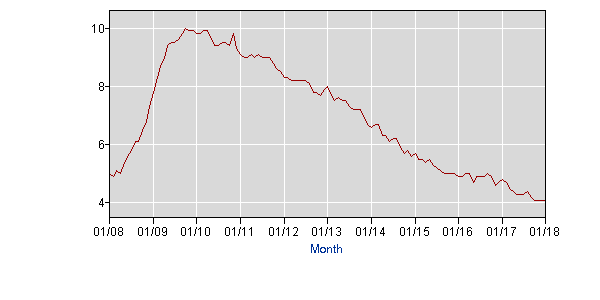
Let’s look at unemployment first. The following chart is taken directly from the Bureau of Labor Statistics for people over sixteen years old in percent of available full-time workers for the last ten years:

Unemployment

The sharp rise in unemployment in 2008 reflects the massive banking crisis that nearly toppled the world economy. The increase continued through the first few months of the Obama administration, but as the chart clearly shows, unemployment peaked at around ten percent at the end of the summer of 2009. After leveling off for six months, the unemployment rate began a steady decline that has persisted for eight years, that is, almost seven years of the Obama administration and the first year of Trump’s.

Everyone who studied economics knows that unemployment is a lagging indicator of the policies of any administration. If you enter a dark room you can simply press a switch, and behold, you get light. But market forces don’t work that way – you can’t create jobs instantly. A reduction in the unemployment rate must lag behind the implementation of even the best possible policy by a year or more. Every administration takes the blame for the failures of its predecessor during its first year, and benefits from its successes.

The chart clearly demonstrates that there is no correlation between the declining unemployment rate in 2017 and any policy implemented by the Trump administration.

Keep in mind, too, that the unemployment rate does not take into account people who have been out of work for several months and have stopped looking for a job. It also doesn’t count people who lost their jobs and decided to return to school and people who work part-time.

The unemployment rate reported by BLS always understates the real unemployment rate. By how much? That’s a great question, but no one knows the answer.

The fact that the decline in the unemployment rate as measured by the Department of Labor in 2017 was largely a continuation of the effect of policies put in place before Trump was elected is basic economics. It’s also interesting to note that the unemployment rate in the United Kingdom has tracked almost exactly with the rate in the United States since 2012, and the unemployment rate in Germany has consistently been between 0.6% and 0.9% lower than ours since 2015. Obviously, neither Germany’s nor the UK’s unemployment rate is related to anything Donald Trump has done as president.

Now let’s turn to the stock market. Market prognosticators come in all flavors, and prior to the 2016 election we were told by some that the equity markets would crash if Trump was elected and by others that it would take off and reach record heights. Most of that was just hot air being expelled from talking heads.

Equity markets rise and fall based on expectations of corporate profits. When you strip away speculation and computerized trading programs, it’s really very simple over the long run. What drove investors during 2017 was the expectation of a Republican tax bill that would greatly increase the prospects for corporate earnings. It was no surprise that 80% of all the benefits accruing from the new tax law will be in corporate bottom lines. Thus, the year-long rally in stock prices.

Can Trump claim credit for the rise in the markets? To some extent he can. He supported it, but the law he signed was a far cry from the one he promised. The new tax law was what Republicans have been trying to pass for decades. Its origins date back to when Trump was a Democrat. Trump may have supported it, but the victory belongs to the Republican majorities in the House and Senate.

If you have a financial adviser you’ve probably asked his or her advice about how to protect your investments and retirement savings in 2017. From where I sit, the most common advice was that speculation was likely to drive the market higher for all or part of the year. But savvy advisers understood that they were looking at a very fragile bubble that could burst at the first sign the administration was in serious trouble. And this administration has flirted with disaster from the very beginning.

Most people who follow stock charting theories believe in the cyclic nature of investment futures. In other words, in the world of investing, history tends to repeat itself. On the 30th anniversary of the stock market crash of 1987, CNBC published a fascinating chart that compared the values of the S&P 500 index for 1987 with those of 2017. Have a look.

Stocks1987_2017

Could the same thing happen today? To the extent that market levels reflect investor confidence, what might happen if that confidence suddenly crashed?

This week has seen evidence that the Trump administration is desperately trying to discredit the FBI, the Department of Justice, and Special Counsel Robert Mueller. Is that just Trump’s obsession with winning or might his administration be in serious jeopardy? No one but Trump’s inner circle know, but if you’re concerned about the psychology of the markets, you surely noticed that the S&P 500 dropped by a whopping 3.7% this week.

Posted in Articles | Tagged , , , , , , , , , , , , , , , | 1 Comment

Draining the Swamp or Trashing the Constitution?

Alan Zendell, February 1, 2018

Populist candidates for president often like to cast themselves as outsiders who will ride in on a white horse and clean up the Washington swamp. Donald Trump did it, and he managed to energize the anger of enough people frustrated by lobbyists and Congressional gridlock to win the election. Portraying himself as an outsider is probably the only thing he’s said since announcing his candidacy that was consistently true.

The problem is that he also described himself as a Conservative. Unfortunately, the meanings of political ideologies have blurred over time, and the definition of a Conservative depends on whom you ask.  Disciples of Barry Goldwater like Jeff Flake will tell you a Conservative believes in the Constitution, has a sound moral center, and respects truth and integrity.

Definitions of Conservatism in English language dictionaries vary but have a few things in common: traditional values, stability, preserving and strengthening established institutions, and resistance to abrupt changes. Trump has repeatedly demonstrated that he believes in none of those things. The only aspects of Conservatism he subscribes to are keeping taxes on business as low as possible and allowing private enterprise to operate free of government regulations. Might those views be influenced by the millions of dollars in profits they represent for him and his family?

Perhaps the most disturbing thing about the first year of Trump’s presidency is his lack of respect for our basic institutions, things like bipartisanship, an independent Justice Department, a co-equal Judiciary, and law enforcement agencies that operate with integrity. Once again he appears to be using the Nixonian playbook of attempting to subvert legitimate investigations by both Congress and federal law enforcement authorities, and undermining our courts.

As horrifying as that sounds to real Conservatives, it’s also perplexing. That approach led Nixon down the road to certain impeachment which he only avoided by resigning the presidency in disgrace. Yet, despite opposition from many in his own party and the thundering outcries from legal professionals everywhere, Trump thinks he can win these battles. He’s been labeled narcissistic and arrogant, but he’s not stupid. Does he think a new Phoenix will arise from the ashes left when he has shattered the pillars of our justice system?

In the 1970s, some Nixon loyalists claimed his only fault was not fighting his enemies to the death. I don’t know what goes on the snake pit of our current president’s mind, but it would be consistent with everything he’s said and done to assume that he thinks Nixon would have survived if only he’d acted more like he does. It can’t be a coincidence that one of Trump’s key political advisers is former Nixon loyalist, Roger Stone. Stone was famously outed by columnist Jack Anderson as one of Nixon’s chief “dirty tricksters,” a label Stone was extremely proud of. It’s also no coincidence that one of Stone’s heroes is Trump mentor Roy Cohn. With Steve Bannon out, is Stone the new voice of the Grim Reaper in Trump’s ear, urging him to fight on and take no quarter until the end?

Trump appears undaunted by claims that he’s headed for a constitutional crisis that will rival the Saturday Night Massacre of 1972. He seems unconcerned that his hand-picked choice to head the FBI, Christopher Wray may be driven to resign in protest if he orders the release of the Nunes memo, but the political firestorm that’s brewing involves more than Wray. It affects the morale of the entire FBI, and is also seen as an indirect attack on Deputy Attorney General Rod Rosenstein. Might he resign in protest too? Might Trump fire him to get at Robert Mueller? And where will Attorney General Sessions come down on all this when he can no longer hide behind silence?

The current furor is about the four-page memo written by Devin Nunes, the chairman of the House Intelligence Committee. Nunes is a political hack of the first order who has already been forced to step out of his role in the investigation of Russia’s interference in our election because of his obvious bias. But it’s not only Nunes. The idea of releasing a memo critical of the FBI by the majority party is a tactic that on its own represents nothing more than political hardball. But preventing the minority report from being released as well changes the game and truly threatens the integrity of Congress.

When the Supreme Court releases a majority decision, it is often accompanied by a dissenting minority opinion. If no one ever tries to suppress the view of the minority in the highest court of the land, how can the Congress justify this decision? I blame Paul Ryan for this mess. Ryan claims to be an honest Conservative (there’s that word again) who stands for what’s best for the American people. He could stop this in a second by deciding to release both memos and let the public decide who they believe.

Posted in Articles | Tagged , , , , , , , , , , , , | 1 Comment

Space

Alan Zendell, January 28, 2018

If you believe Stephen Hawking, Neil deGrasse Tyson, the late Carl Sagan, and countless other scientists, space exploration may be the only thing that guarantees the survival of the human race. Two events coming up in the next couple of weeks bring the dire predictions that led to that conclusion to mind.

Next Sunday, during Super Bowl 52, an asteroid large enough to cause a total extinction event, were it to collide with our planet, will pass by the Earth’s orbit. It won’t come closer than 2.5 million miles, more than ten times further than the Moon – not a near miss even in astronomical terms – but the next one might be a lot closer. The astrophysics and astronomy communities consider such an extinction event a statistical certainty. The only uncertainty is when it will happen.

It has happened before, after all. Sixty-five million years ago, a six mile diameter asteroid impacted Earth and caused catastrophic changes, altering the angle of the Earth’s axis and drastically modifying our planet’s climate. That’s why there are no dinosaurs today and why we were able to evolve. The next one might well cause humans to suffer the same fate.

Fifty thousand years ago, a much smaller object, only 160 feet (half a football field) in diameter caused a ten megaton explosion which left a 550-foot deep crater nearly three-quarters of a mile wide in the Arizona desert. But don’t let those large time intervals fool you. In 2018, seven known asteroids large enough to cause massive devastation will pass within less than a million miles of Earth. At least 10,000 asteroids are known to exist in near-Earth orbits around the sun. They are all routinely tracked by the Panoramic Survey Telescope and Rapid Response System in Hawaii, but the key word in the above is “known.”

Most near-Earth asteroids are discovered accidentally, by amateur astronomers. No one really knows how many there are, but the number is surely staggering, and an object can’t be tracked until it’s identified. That’s why scientists consider an eventual impact a near certainty, and they believe the only way to assure the long-term survival of humanity is to establish viable, self-sustaining habitats in outer space. These could be settlements on the Moon or Mars, space stations, hollowed out asteroids, or generation ships built to carry thousands of passengers for hundreds of years toward other solar systems.

When I was a kid reading science fiction in the 1950s, conventional wisdom said we’d have bases on the Moon and Mars by the end of the century. But once it became clear that those bases offered no military advantage, most of the funding for researching such space ventures quickly dried up. The decline of our manned space program since the Moon landings, the last of which occurred forty-five years ago, was based on economics. Manned exploration is risky and expensive, and without an obvious payoff there was no political support for continuing it as a government program.

Fortunately, private sector visionaries like Elon Musk believed that space exploration could be profitable, and companies like his SpaceX have proved them right. They’ve been quite successful launching satellites for business and military ventures, and have innovated ways of dramatically reducing costs. But while space has become a profitable industry, the most important benefits may lie in the future. The private sector may well become the salvation of the human race.

On February 6th, SpaceX is scheduled to launch what will be the most powerful rocket booster in the world. It won’t generate as much thrust as the Saturn V booster that sent the Apollo spacecraft to the Moon, but it’s far more efficient. To prove the point, Musk will use February’s test launch to send a Tesla automobile into orbit. It’s obviously a publicity stunt, but the underlying subtext is real. Musk says the rocket known as “Falcon Heavy” is capable of sending a manned mission to Mars.

That’s the real goal, and there are plans to have a viable base there by 2030. This is no longer science fiction. It’s the beginning of the next stage of the evolution of humanity. The odds of a cataclysmic impact of an asteroid destroying our civilization this year or next are very small, but projected ten, twenty, or hundreds of years into the future they grow significant. We will put future generations at risk of annihilation if we don’t provide them a safe place to live.

Posted in Articles | Tagged , , , , , , , , , , , , , | 2 Comments

Dreamers and Borders

Alan Zendell, January 25, 2018

The Trump White House offered what they described as a significant compromise on immigration today. On its face it looks like that’s true. It not only offers the three quarters of a million DACA kids a path to legal residence and citizenship, but it offers provisions that include another million such individuals.

In exchange it asks for a $25 billion trust fund for future border infrastructure and technology, some vague provisions that would enable the government to deport an unspecified number of presumably illegal immigrants, and an end to what they refer to as chain migration. That latter specifically would not apply to spouses or minor children.

It doesn’t specifically say that a border wall will be built, but we really don’t know the details yet. In principle it sounds like the centrist proposal the White House claims it is. Like any good centrist plan it will infuriate extreme factions on both the right and the left.

As he loves to do, Trump took everyone by surprise with this plan. The Alt-Right won’t like it because it might result in allowing almost two million people of various colors to become citizens – not exactly a recipe for white supremacy. And the “lefties” won’t like it because…I’m not entirely sure, specifically. They like to quote the inscription on the Statue of Liberty: “Give me your tired, your poor/Your huddled masses yearning to breathe free,” and they declare any tightening of immigration policy, especially the idea of letting people in based only on merit, as a violation of our basic principles.

As always, the devil will be in the details. It’s easy to generalize, but when the proposal is fleshed out it may look very different. Perhaps the biggest problem facing it is that Trump has publicly taken every possible stand on immigration during the last three years, some more than once. He loves to play bait and switch with Congress and the voters. He no doubt thinks of it as brilliant negotiating tactic, but for the majority of Americans, it only makes the credibility of everything he says suspect.

My overall dislike and distrust of Donald Trump aside, I consider myself centrist in most ways. The proof of that is that if I truly believed he was serious this time, and there were no serpents hiding beneath the generalities, I could support this proposal. For one thing, it does seem to align with what most Americans say they want – compassion and a fair deal for the “Dreamers” and better border security. I admit I’m nostalgic for the days when I could drive into Canada with only my credit cards and a driver’s license, but I have to be realistic. Those days are gone.

We don’t yet know what border security will ultimately look like, but the Idea of a $25 billion trust fund makes some kind of sense. And the words “infrastructure” and “technology” cover a lot of ground. Most security professionals believe our greatest vulnerability lies in cyberspace. An electronic shield that protected the country from hacking everything from our military installations to our voting booths might be defined as a border wall, and I can’t think of any objection to having a deep trough of money available for when it might be needed, not to mention all those high tech jobs it will pay for to employ all those dreamers; you know, the ones who’ve been at the head of their class for years?

The thing about creating a large trust fund is that it will be up to future Congresses and administrations to determine how it is used. If they use it well, it might be a very good thing. And if it actually works out that nearly two million vulnerable immigrants are given a meaningful path to citizenship, that definitely will be a very good thing.

As usual with Donald Trump, the issue comes down to trust. Can we believe him? And even if we do, attempting to broaden his base by adopting progressive ideas is a big risk. Will he do what he’s done repeatedly and change his mind when the more extreme among his supporters scream foul? Or will he show leadership and courage, and demonstrate that he really wants to unify the country?

I for one am willing to keep an open mind. I have no reason to trust the president, except that I’m an incurable optimist. There’s no rationale that makes me believe he wants to improve things based on his performance in 2017, but I’m willing to take the bait, and wait and see.

It’s not that I think Trump deserves another chance. There’s really no alternative except to behave as close-mindedly as the people I criticize.

Posted in Articles | Tagged , , , , , , , , , , , , , , , | 3 Comments

Racism and Other Distractions

Alan Zendell, January 15, 2018

Donald Trump is not a racist. In fact, the term racist is an oversimplification that simply doesn’t apply to someone like him. The things that drive him have little or no relation to what most of us think of as basic moral values. So let’s stop muddying the waters by throwing terms like that around and then polling everyone in sight to find out if they agree.

Whether or not our president is a racist should not be the subject of a poll or referendum. That’s the kind of distraction we need to learn to avoid. It’s exactly the sort of thing Trump loves because it takes our attention away from the things that are really important.

Racists generally come in two flavors: ideologues and ignorant, uneducated people. Whether or not he is a stable genius, it’s fair to say that Donald Trump is neither of those. The ideologues are the Alt-righters, the Klan types, the neo-Nazis, and some of the more virulent survivalists. But those groups are far outnumbered by people who suffer from rampant ignorance.

They aren’t necessarily bad or immoral, just unenlightened and unaware, to put it politely. I learned that lesson the summer I was seventeen. I was at an orientation meeting for a summer job, working for the Herald Tribune Fresh Air Fund, which provided a place for ghetto kids to escape the city for a few weeks. Four of us, all New Yorkers, were sitting around a table congratulating ourselves for doing such virtuous work when we were joined by a fifth.

Tom was about twenty, a rather oblivious young man who spoke with an exaggerated southern drawl which we all found amusing. He was a decent-seeming kid from some rural place in Alabama that none of us had ever heard of, who was as wide-eyed as he could be about being in New York, actually about being out of Alabama for the first time. His father, a Baptist minister, had sent him up north on a mission of sorts.

As Tom babbled on it became clear that he felt helping poor “Negro kids” was doing God’s work, but what occupied most of his attention was that he’d been told he might encounter Jews in New York. He went on for fifteen minutes about how excited and nervous he was about that. At one point he said, “I’ve never met one before, have any of you? Some people back home say they have horns.” Admittedly, this was back in the dark ages of 1960, but seriously?

We assured him that that wasn’t true, and he said, with some trepidation, “I can’t wait to meet one.” Give Tom credit – he was willing to meet the Devil no matter how much it scared him. That was when we told him he was the only one at the table who wasn’t a Jew. Poor Tom was literally white as a ghost. We got to know him pretty well that summer and learned as much about our own naïve prejudices as we did about him. He was really a pretty good guy.

Donald Trump is nothing like Tom, and he’s not a neo-Nazi. He’s neither a racist nor an anti-Semite. What he is, however, is actually a lot worse.

Our president is an amoral panderer totally lacking in sensitivity and compassion. He understands ignorance and hate, and he has an intuitive feel for how to ignite those things, which he uses effectively and without compunction to arouse people’s worst instincts. He is a talented showman with a narcissistic lust for power and wealth, and that’s all we really need to know about him.

Since he announced his candidacy, he has frequently been compared to some very unpleasant people, like Roy Cohn, Joseph McCarthy, and Adolf Hitler. That doesn’t necessarily make him evil, but it does make him very dangerous. In a couple of days, Senator Jeff Flake (R, Arizona) will step to the podium of the Senate and deliver a speech that compares Trump to Josef Stalin.

Trump doesn’t hate African Americans, Hispanics, or Jews, but he knows how to energize people who do to get what he wants. He is the worst kind of predator who takes advantage of anyone more vulnerable than he is, and he is totally shameless. He has the mentality of the unscrupulous late nineteenth century robber barons whose greed knew no boundaries.

It’s important to be clear about who and what our president is. His first, second, and third priorities are Donald Trump. He only cares about other people and the country he’s supposed to be leading to the extent that without them, his wealth and power would be meaningless. Don’t ever expect him to change and don’t expect him to be impeached. He’s going to be president for at least three more years, and the only way to contain him is to vote next November and work for candidates who will counter his hatefulness.

It’s only 289 days until Election Day.

Posted in Articles | Tagged , , , , , , , , , , , , , , | 2 Comments

Shithole Countries and the Free Press

Alan Zendell, January 13, 2018

Since the end of the second world war, we’ve had a succession of presidents who, regardless of their overall political philosophies, all believed that increased trade and friendly, cooperative interaction with other nations were the best recipe for peace and prosperity, not to mention their personal legacies. But in the Age of Trump, governing the country the way he ran his businesses means changing that. In the Trump business world, things like fairness, mutual respect, morality, and law were sidestepped any time they got in the way of profit. All that mattered was size and money, and it’s clear that if Mr. Trump has his way that’s how our government will be run.

One can only wonder how many smaller firms, customers, and business associates he trampled for the sake of convenience, and why not? In Trump’s terms there was no reason to be fair to shithole companies, shithole customers, shithole cities, or even shithole business partners and subcontractors. Is anyone surprised that our president views the rest of the world the same way?

It’s not entirely clear which countries are on Trump’s Shithole List, but it’s safe to assume that if you’re in Africa or in the western hemisphere south of the Rio Grande, you’re on it. A special exception is the American Territory of Puerto Rico. They were already on the Shithole List anyway, but putting an official stamp on it will make it easier to ignore the complaints about lack of aid for three million American citizens in desperate need.

Like the majority of Americans, I reacted to Trump referring to Africa as a continent of shithole countries with disgust and dismay, but not anger, at least not at Trump. My anger is directed at everyone, myself included, who has continued to take every piece of bait he throws out and blow it up into something far more important than it is. In doing so we help him pump up his base, who love nothing more than seeing him stick it to whatever straw man represents their anger and frustration.

The truth is that Trump’s slurs are meaningless. The only substance they have is what we give them. As the courts have ruled, he does not have the power to decide who gets into the country and who doesn’t. We should follow the lead of foreign leaders who put up with him because they have no choice, while silently awaiting a chance to make him pay. They know he will disappear one day, and it’s very likely that Trumpism will disappear with him.

When Congress goes along with his nonsense, it’s on them, which explains why their approval rating is even lower than his. It’s too much to expect most Republicans in Congress to call the president out to his face the way Lindsey Graham did. Most of them will remain silent, and many may even have valid reasons for doing so. But if those silent Senators and Representatives allow the president’s inappropriate and frankly disgusting words and tweets to find their way into law, we will have a real problem.

If Trump’s hateful rhetoric ever becomes policy, that’s a whole other ballgame. But so far, whether it’s Shithole Countries or threatening the fake news media, Trump remains an egotistical loudmouth bully who is 98% bluster. Don’t be taken in by him. He has neither the legal authority nor the guts to see his threats and slurs through to meaningful action, and if he tries to, the American system is still strong enough to stop him.

What goes around usually does come around. Consider the silent revenge of Puerto Rico. NBC News reports that nearly a quarter million people have moved from the island territory to Florida since Hurricane Maria. They’re all American citizens who can register to vote there. Imagine the irony if they turn Florida into a solidly blue state. Well done, Donald!

If you doubt that he can be stopped, go to see Steven Spielberg’s new film, The Post. Watching it was one of the most uplifting things I’ve done since the election. The theater was full, and it was no accident that everyone in it had gray hair. For my generation this film relived a truly terrifying period in our lives which affected everyone. Of all the horrors surrounding the Vietnam War, the worst part was the Nixon administration’s attempts to silence the free press.

The film takes us through the agonizing decision made by the Katherine Graham, the owner and publisher of The Washington Post in 1971. She was a lone woman in a world of powerful men, pitted against not only the government but her Board of Directors and legal staff, all white males. Her courage in standing up to Nixon and risking prison and financial ruin literally brought tears to our eyes. The timing of the film’s release and the fact that Spielberg cast the marvelous Meryl Streep as Mrs. Graham makes it absolutely clear that The Post is aimed squarely at Donald Trump.

It scores a direct hit and reminds us what our country is really made of.

Posted in Articles | Tagged , , , , , , , , , , , , , , , , | 1 Comment