Seventh Grade Civics

Alan Zendell, March 14, 2017

I am frequently amazed at how little the average American understands about the way our government works. Admittedly, thirty-seven years as a federal employee gave me a leg up, but what was everyone else doing in seventh grade civics? Here’s what they missed when they were sneaking cigarettes in the rest rooms instead of paying attention.

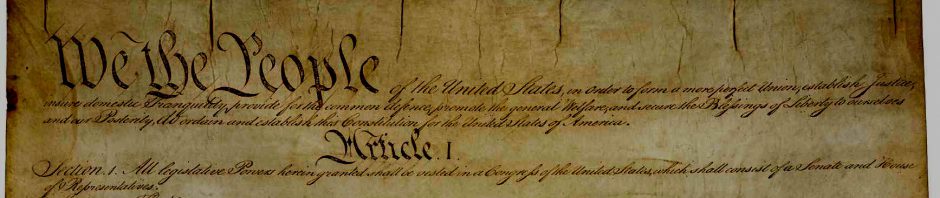
Our government, as provided by the Constitution, is divided into three branches. The Congress, which consists of the Senate and the House of Representatives, makes our federal laws, the most important of which specify how much money the government can spend each year. The Judiciary is charged with determining whether those laws are constitutional when someone challenges them. And the Executive Branch assures the laws Congress passes are carried out. That’s it, except for incidentals like declaring war. Only Congress can do that, legally, but the President can make the issue moot by ordering military actions without Congress’ approval.

The President can lobby for things he wants done and make budget proposals, but the only power he has in that regard derives from political pressure and skillful use of his bully pulpit. When Donald or Hillary or Bernie said, “When I’m president I’m going to…”, they usually meant, “I’m going to try to convince Congress to do it”. Presidents can’t cut taxes, grant universal health care, declare that colleges will no longer charge tuition, or hire contractors to fix bridges and highways.

Every president in recent memory promised to cut spending as soon as he took office. One actually did, though he was foiled by the Law of Unintended Consequences, which takes precedence regardless of which party is in power. In 1981, President Reagan ordered a 15% cut in administrative costs across all executive departments, something he could do legally, because all the department heads reported directly to him. Everyone applauded him for keeping his promise, except the people who had to carry out the order.

It was reality check time. In those days, my corner of the world was Medicare administrative costs, but the same issues applied across government. The problem was that over 90% of administrative costs were locked in. Most of them were allocated to fund the contractors that ran the program day-to-day, with the remainder going to pay for the federal employees charged with overseeing them.

The only way to reduce latter was to institute a hiring freeze. Wholesale firing or laying off of government employees is a nonstarter, as President Trump is about find out, and infrastructure costs (buildings, government vehicles, general overhead) were already committed. We did the only thing we could do – pass the cuts on to the contractors, but they had the same problem. If they reduced staff, they wouldn’t be able to process medical claims, and personnel and building costs made up almost all of their budgets. The cuts had to come from “discretionary” spending, which was almost entirely devoted to audit activities. In the end, most estimates found that firing the auditors cost Medicare about $40 for every administrative dollar saved, because no one was keeping the foxes out of the hen house. Nice try, Ronnie. Better luck next time.

My seventh grade civics class didn’t mention the Congressional Budget Office (CBO) because it didn’t exist until 1975. It was created to be a nonpartisan group of economists, policy experts, and researchers that would be an objective referee in all matters of legislative budgets. Interestingly, the current director of the CBO was appointed by a Republican congress, key among which was current Health and Human Services Secretary Tom Price, then the chairman of the House Budget Committee. That same Tom Price is now accusing the CBO of complete incompetence in scoring the administration’s new health care legislation, the American Health Care Act (AHCA).

Trump’s people act as if they were blindsided by the CBO’s findings although everyone involved in the creation of the AHCA knew in advance that it would deprive tens of millions of Americans of health insurance. Was their plan all along to discredit the CBO the same way they have demonized the media (and everyone else who disagreed with them)?

This is a classic case of very large square pegs not fitting in very small round holes. It doesn’t work. There’s no way to provide affordable health care for everyone without a huge increase in cost. The CBO estimated that the AHCA would reduce costs by $338 billion. It’s impossible to cut expenses that much and keep the President’s promise. No amount of smoke and mirrors will change that.


Posted in Articles | Tagged , , , , , , , , , , , , | Leave a comment

The Truth About Health Care

Alan Zendell, March 8, 2017

Most of what you read in the media about health care in the United States is exaggerated, spun for political reasons, or outright lies. Health care is a very complex issue until you strip away the special interests and politics. Then it becomes extremely simple.

Although our Constitution explicitly charges the government with promoting the general welfare of the population, in recent years, the word entitlement has become associated with greed and laziness. Our Bill of Rights guarantees every citizen the freedom of speech and worship, the right to bear arms, and host of other entitlements that we take for granted. The Declaration of Independence asserts that every American is entitled to “Life, Liberty, and the Pursuit of Happiness”, yet none of our foundational documents makes explicit mention of health care.

Does that mean our founding fathers didn’t believe basic health care was a right of every American? No. It means that in the mid-eighteenth century there was no health care as we know it, and Jefferson and Adams can be forgiven for not being prescient about how medical science would evolve.

When the question of health care as an entitlement is posed today, the most common response is, “Who’s going to pay for it?” That is the real heart of the matter. Had the Bill of Rights elevated health care to the level of firearms, we wouldn’t even be having this conversation in 2017. Our economic development would have included the need to pay for health care at every turn. Instead, our country now has a huge divide which may be impossible to bridge. That divide is what gave birth to the Tea Party. Ignore the rhetoric. What the Tea Party is about is preventing the enormous transfer of wealth that would be required to fill the gaps left by the founders.

When Bernie Sanders asserted that every American had the right to decent health care, he made the mistake of labeling himself a Socialist. The society he proposed looks very much like most of the social democracies of Europe. Is Germany a socialist country? Is Holland or Denmark?

When our politicians are asked why America is the only industrialized democracy without a national health care system, the answer most often given is that the cost would too high here. But that answer is incorrect. Health care costs in the Netherlands and Australia are as high as ours, yet both countries have federally funded health care. The right answer is that our priorities are wrong.

Representative Jason Chaffetz (R, Utah) essentially said the same thing, yesterday, only he got it backwards. Chaffetz said individuals needed to decide whether to spend their incomes on iPhones or health care. You could by a new iPhone every two weeks, and still not spend as much in one year as the average unsubsidized health insurance plan costs in the United States.

Chaffetz should have addressed the top of the food chain. It’s a simple matter of taxes versus expenditures, and the bottom ninety percent of the population is already taxed to the limit. There’s no question that America can afford to provide quality health care for everyone if it has the will to do it. Most of Europe funds national health care through a value added tax (VAT) of about twenty percent, paid on every consumer item except basic necessities. No complicated income tax structures with entitlements for groups powerful enough to get them legislated, just the kind of simple tax structure most so-called conservatives claim to prefer.

If you believe our country has a moral responsibility to assure the health of every American, you have to be realistic. Most of the wealthiest people in America will fight to the death to avoid the kind of transfer of wealth that would make that possible. And they will win, unless people fight back at the ballot box. The only chance to have a level playing field in health care in this country is if the voters replace those people in Congress who don’t want one with people who do.

If every congressional district that went for Sanders in 2016 votes that way in the 2018 mid-term elections, we’ll have a fighting chance. The choice isn’t between iPhones and health insurance. It’s between how many yachts and private planes and country clubs are worth the health of the people who build and service them. Americans don’t need tax credits. They need a guarantee that the cost of dealing with illness or injury will not devastate their families.

It really is just that simple.

Posted in Articles | Tagged , , , , , , , , , , , , , , , , , , , | 4 Comments

Early Warning Signs

Alan Zendell, March 6, 2017

Most of us have been conditioned since childhood to recognize warning signs and heed them before the trouble they portend hits us in the face. Most Americans are optimistic by nature. It’s one of our great strengths unless it morphs into denial about impending problems.

There’s a nearly irresistible temptation to assume that the brake fluid puddled under your car must have come from someone else’s vehicle or that the baggie filled with a suspicious substance you found in your teenager’s pocket must have been planted there by someone else. How many red flags does it take to wake us up?  I’ve even been shocked, lately, by the number of people who ignore tornado warnings.

TornadoWarning

I’m old enough to remember Watergate, when President Nixon’s denials of wrongdoing and his increasingly aberrant behavior over many months resulted in a crisis of confidence even among his most ardent supporters. By the time they realized the situation couldn’t be salvaged, it was too late. We had a dysfunctional president whose Chief of Staff, retired General Alexander Haig, had to build a firewall around him. In the end, Richard Nixon resigned in disgrace to avoid impeachment.

My friends and family are sharply divided. Some are convinced there are already sufficient warning signs that President Trump will severely damage the country; others repeatedly say, “Give him a chance”. I confess that I am in both camps, the first because after a lifetime of exposure to Donald Trump’s antics, I see no reason to believe he has what it takes to succeed as President. But I also think we have to give him a chance – either to show he can succeed or to hang himself. Like the parent who knows his kid is lying when he confronts him with the illegal drugs he found, part of me wants to wait and see while another part is screaming that I have to do something before it’s too late. Seven-and-a-half weeks into this administration, the second voice is beginning to overwhelm the first.

A president swept into office on a wave of populism whose party has firm control of both houses of Congress should be sailing on smooth waters. With two years to go before the next Congressional election, they have plenty of time to get their ducks in a row to pursue the agenda for which they believe they’ve been given a mandate. But what has this administration done?

It rushed to issue an attempt to obstruct immigration by specific religious groups thinly disguised as a security-related travel ban, when a more thoughtful and deliberate approach could have passed muster easily. They set about dismantling regulations and defunding NOAA, both of which we desperately need to protect our deteriorating environment, removed a federal objection to an obviously discriminatory voter registration law, and intervened in a civil rights discrimination case already decided by the courts. And the President himself, while being advised by his own party to get his personal behavior under control, continues to makes outrageous accusations against everything and everyone he dislikes, with not a shred of evidence to support them. He’s a master at changing the conversation when he doesn’t like the subject, but where will that get him if nothing is accomplished? Worst of all, he hasn’t shown me that he possesses the moral center essential to being an effective leader.

His own party seems more terrified of him than the opposition. I never imagined I could feel sympathy for Senator Mitch McConnell after he announced, shortly after President Obama took office, that his goal was assuring that Obama failed as president. Or for Paul Ryan, who despite his vaunted integrity, could never bring himself to tell the truth about Trump’s outlandish and immoral behavior. But such is the disarray that Trump has created in his own party, I wouldn’t be in either of their shoes at any price.

There is no reason to believe the Republican led Congress will fund any of the major initiatives Trump promised during the campaign. Not the $3 trillion plan to create jobs rebuilding our crumbling infrastructure or fulfilling Trump’s promise of affordable health care for every American, and surely not his Mexican border wall. They’re all pipe dreams doomed to fail. And jobs? Let’s see what happens when he tries to get Congress to impose penalties or tariffs on companies that have already shipped millions of jobs overseas, when their billionaire corporate patrons tell them to vote “Nay”. What will his supporters do then?

More importantly, what will all of us Americans do at the ballot box in 2018? How long will we wait before we accept that our national train is going off the rails? Will we simply bemoan our options as we did in 2016, or will we recognize that some paths are far worse than others?

Posted in Articles | Tagged , , , , , , , , , , , , , , , , , , , , , | 3 Comments

Music Therapy

stetson

Alan Zendell, March 3, 2017

Last evening, I attended a concert by the marvelous Stetson University student orchestra. I was greeted by this plaque at the entrance to the concert hall. Lovely, isn’t it?

I said it was a concert, but it was really much more. Musicology professor Daniil Zavlunov spent the better part of an hour dissecting Beethoven’s Fifth Symphony, with the orchestra playing snippets to illustrate the professor’s points. Then, with the audience properly primed, the orchestra launched into the complete work with spellbinding effect. As many times as I’ve heard that pivotal symphony, I had never heard or appreciated it the way I did last night.

As Professor Zavlunov frequently noted, no one really knows what drove the great composers to write what they did. Nonetheless, he offered a very plausible defense of the idea that the Fifth Symphony’s power and greatness was Beethoven’s celebration of coming to terms with the personal tragedy of going totally deaf before and while he was composing it. To greatly oversimplify a very complex subject, the home key of the symphony, C minor, represents the depth of his depression and desolation as he realized he was losing his hearing forever. The alternation throughout, between C minor and C major, are, in effect, mood swings, as he fought to overcome his loss, and the symphony’s triumphant finale in the major key is a powerful expression of Beethoven’s personal victory over his affliction.

Thus, the professor took the audience on a journey of discovery. I’m certain that everyone related to it in his or her own personal terms. My internal journey, seated within thirty feet of the violins and french horns, very much mirrored my mood swings over the last four months.

Much of what the professor explained reminded me of another pivotal symphony, Schubert’s Unfinished #8. Again, no one knows for sure either why he composed it as he did or why he never finished it. But we know that he was writing it as he was coming to terms with the syphilis that ultimately ended his life, and was likely in considerable pain and discomfort. He also chose a minor key (B minor) to express his anguish, with violent alternations between minors and majors, much as Beethoven did in his Fifth.

The professor noted that if Beethoven’s symphony had been missing its final movement it would have felt terribly incomplete. That remains true for Schubert’s, which is missing its final two movements. Even so, I have always found listening to it uplifting.

Today is my birthday, an event I usually try to ignore, but this year I decided it was better to offer everyone else a gift. If you too have spent the last four months in a funk, I don’t have to tell you that it’s time to shift gears. We can’t afford to sleep through the first year of the Trump administration.

My gift to you is the magic of music therapy − you don’t need drugs for this. Get yourself a good pair of headphones, turn off your smart phone, and find a comfortable chair. Let yourself feel whatever has been keeping you down and turn on the music. Start with the Schubert and move right into the Beethoven. Let the music lift your spirits. You’ll be amazed at how good you feel as the triumphant final movement comes to a close.

If that doesn’t work, maybe you do need drugs.

Posted in Articles | Tagged , , , , , , , , , , , | 1 Comment

Giving Back

Alan Zendell, March 2, 2017

I often think of the 2000 film, Paying it Forward.  In retirement I tutor kids, mostly teenagers, in math and science, though our conversations tend to stray into many other areas. I find them surprisingly open and eager to discuss values, families, politics…you name it, and the issue of paying forward often comes up in two very different ways.

The majority of the kids are the children of immigrants. Their families come from India, Pakistan, China, Korea, Tibet, Vietnam, the Caribbean, Kenya, Nigeria, Liberia, Ghana, and probably a few places I missed. They’re Christians, Muslims, Hindus, Sikhs, even Jews. Remarkably, their families all have two things in common. The kids are taught to obey rules and respect adults, and their parents sacrifice everything to assure their futures. Since I’m old enough to be their grandfather, I hear all the complaints. Why are they so hard on us? Why can’t we have fun? I’m always surprised that I have to explain, but I tell them it’s all about paying their generation forward for what their parents and grandparents did for them.

The other way it comes up is when we talk about materialism, though we never use that word. Smart and talented as most of them are, these kids can be extremely naïve about the world. They assume that we (their tutors) are all well paid, and why shouldn’t they? After all, they look up to us, and they value what we give them, so of course we must get fat paychecks for it. Some of my work is modestly compensated but much of it is voluntary. In either case, the kids are initially amazed. Why would we do this and receive so little (or nothing) in return (a question I hear from some retired friends as well)?

I explain that there are many currencies in which we can be paid, and that after a life in which we’ve had many opportunities to succeed, some of us feel compelled to give something back. The idea that their success is our reward doesn’t always sink in right away, but when I explain it in terms of things they can relate to – evolution, recycling knowledge, preparing the next generation to carry the torch – they get it.

Thus I am always aware of a responsibility to behave properly and morally when I’m with them. I don’t mince words over political correctness, but I always tell them the truth. I’m part of a vast network that includes their parents, grandparents, and school teachers that are helping them through the critical formative years of pre-adulthood.

I see their confusion when our leaders do things that seem to conflict with the values we teach them, and it fills me with pain that often boils over into rage when I have to confess that I understand and share their confusion. As teens, the only president most of them have been aware of was Obama. Agree with him or not, and politics aside, his image as a parent and leader coincided perfectly with everything they were taught a leader should be. They admire him almost without exception.

The entry of Donald Trump on the political scene nearly two years ago, shocked their sensibilities. For months I heard questions like, “How could he possibly….”? That sentence had a hundred different endings, and when I heard it from a fourteen-year-old boy or a sixteen-year-old girl, I didn’t hear politics. I heard the kind of anxiety that arises when a young person fears that everything he or she has been taught might be unraveling. When a sweet young girl breaks down in tears because her mother tells her she can’t tell people she is Muslim any more, something must be terribly wrong. Many kids told me that their whole worlds were turned upside down, that this wasn’t the country they’d been told their parents and grandparents said would offer them a better life.

The thing is, it’s not just the kids I tutor that I fear for. My own grandsons are growing up in this world, too. I’m thankful that they’re not yet old enough to understand what comes out of Trump’s mouth. I honestly have no idea what he really believes, but I am certain that without moral leadership he will do far more harm than good as president.

Posted in Articles | Tagged , , , , , , , , , , | 3 Comments

Is it Fair to Compare Trump’s Rise to Power with Hitler’s?

Alan Zendell, February 23, 2017

Google “Hitler and Trump”, and you’ll be shocked at the number of websites that come up.  They by no means agree with each other, but it’s significant that so many diverse people thought to make the comparison. Even Harry Potter chimed in, as a Twitter war erupted between his creator, J. K. Rowling and the British interviewer, Piers Morgan (https://pjmedia.com/lifestyle/2017/02/11/j-k-rowling-mocks-piers-morgan-for-refusing-to-compare-donald-trump-to-adolf-hitler/).

I did my own comparison shortly after Trump announced his candidacy for President. It seemed to me that he was running his campaign directly out of Hitler’s playbook, otherwise known as Mein Kampf. I imagined I had originated that notion, but Hitler biographer Ron Rosenbaum used it prominently in the weeks after Trump’s inauguration (http://www.independent.co.uk/news/world/americas/adolf-hitler-donald-trump-mein-kampf-bluffed-way-to-power-nazi-leader-germany-fuhrer-us-president-a7568506.html).

That is not to suggest that Trump will govern like Hitler or that he aspires to the kind of atrocities Hitler’s Reich committed. That his tactics were similar is undeniable. We all saw the election campaign, and most of us on all sides were revolted by it. But employing similar tactics doesn’t imply having identical goals and ideologies. Only time will tell.

Scapegoating: Hitler demonized Jews throughout his career, labeling them pure evil. That view wasn’t original to him; it grew out of the neo-Darwinist ideas of two generations of antisemitic writers and philosophers who preceded him. He played on the frustration and fear of a population dealing with the aftermath of World War I, in which the rest of Europe brutally punished Germany. Hitler used Jews as the scapegoats for his ultra-nationalistic rants, accusing them of stabbing Germany in the back and causing their defeat, and his hyperbolic appeals to the unemployed and impoverished survivors brought him to power.

Trump began by demonizing whole nations and religious groups; unless you live in an alternate reality that’s a fact. I don’t believe Trump hates Muslims and Mexicans the way Hitler hated Jews, but the strongest weapon in his campaign was his appeal to fear and bigotry, with precisely the same kind of hyperbole that Hitler used so effectively.

The News Media: Hitler understood that to rise from an insignificant member of a fringe political party to national prominence he had to discredit the press. He did it within the law, using wealthy contributors to force opposition newspapers and radio stations into bankruptcy, until the Nazi Party controlled all the major news outlets.

Trump’s people coined the terms “alternate facts” and “fake news” to capitalize on the general disdain most Americans, myself included, felt for the media. Looking back on 2016, it’s almost surreal to imagine that a candidate could successfully label every opinion he didn’t like a lie, and convince a large portion of the electorate that every media outlet but one was part of a vast anti-Trump conspiracy. Is the United States entering a period of buyer’s remorse?  The latest Quinnipiac Poll reported that Americans now believe the press more than they believe Trump by 52% to 37%. Only three out of every eight Americans believe he’s truthful after one month in office.

Consolidating Power: In 1923, Hitler was convicted of treason and spent nine months in prison for provoking a failed coup in Bavaria. After that, however, his rise to power was entirely lawful. Political bullying and threats by the growing Nazi Party, an extension of Hitler’s decade long politics of hate and fear, forced German President von Hindenburg to appoint him Chancellor (Prime Minister). Trump’s rise to power was also accomplished within the bounds of our legal structure, in a populist wave of masterfully orchestrated rage against the establishment.

My question is, what can we reasonably infer from the disturbing similarity of Trump’s tactics to those employed by Hitler? Trump’s chief strategist, Steve Bannon, made no secret during his years of extremist writings, that a strong executive powerful enough to neutralize all opposition would be best for the country. Does Trump believe that too?

Americans need to pay close attention to everything this administration does. No more burying your head in the sand because you’re so horrified about the outcome of the election. Passivity is the surest course to disaster.

There is no evidence that we’re headed toward autocracy, but there’s an essential lesson in Hitler’s actions as Chancellor. In 1933, political violence instigated by the Nazis escalated almost to the level of civil war. In an effort to maintain order, the Reichstag (parliament) passed the Enabling Act, which granted the Chancellor (Hitler) emergency powers to act without consulting the rest of the government. Those emergency powers were never rescinded, and most historians cite the passage of the Enabling Act as the pivotal event in Hitler’s rise to absolute power.

Could that happen here? My concern is that if any sort of terrorist attack were to occur on American soil, the Bannon/Trump administration would immediately react by asking Congress to grant Trump emergency powers for “the duration of the crisis”. That must never be allowed to happen. That is when millions of Americans must raise their voices in protest.

Posted in Articles | Tagged , , , , , , , , , , , , , , , , , , , , , , , , , , , , , , | 6 Comments

Warcraft and Governance

Alan Zendell, February 20, 2017

On February 7th of this year, the lead article in James Hohmann’s The Daily 202 (a daily news capsule put out by The Washington Post) was Five books to Understand Stephen K. Bannon. The week before, a long-time associate of Bannon had told a cable news channel that his “bible” was The Art of War, by Sun Tzu.  Written in the fifth century A.D., that tract is still considered a classic work of military strategy.

Why was this important? Because President Trump appointed Bannon as his chief strategist. One can never say for certain who is whispering what in the President’s ear, but it’s safe to say that the advice of his chief strategist matters. So I obtained a copy of The Art of War and devoured it, looking for correlations with the first month of the President’s actions. Fortunately, I didn’t have to look very hard.

Trump had often stated himself that he intended to be unpredictable because that kept his opposition off guard and strengthened his position. And regardless of who you believed, it was clear that Trump’s version of what was true and what was not usually differed from the establishment’s. For whatever reason, his bombastic campaign of attacking everything he didn’t like, calling every differing opinion a vicious lie, and labeling every media outlet that criticized him a failed enterprise spreading fake news, succeeded.

Trump was masterful at misdirection, diverting attention, and creating chaos among all those who opposed him. Feint here, attack there, strike quickly, and show no mercy in battle − exactly what Sun Tzu prescribed as the formula for victory in war.  Whether or not he was a devotee of Sun Tzu, you have to give Trump credit for recognizing that his political campaign was a perfect allegory for war.  In many ways, of course, his business career displayed the same qualities.  One never lays his cards on the table when negotiating a business deal. It’s all about deception, creating false expectations, and knowing when to strike.

As unpleasant as the election campaign was, unless Congress finds collusion with Russia, Trump didn’t violate any laws. Political campaigns really have no rules.  The assumption is that the voters will punish any candidate who behaves really badly. All is fair in politics and war.

But is the same true for governing? We’ve now seen Trump (and presumably Bannon) apply the art of warcraft in two scenarios.  As I see it, he’s in an entirely different arena now. In addition to adversaries, he must deal effectively with allies, the loyal opposition at home, the courts, and the press. And my question is this: should the President treat all of those entities in the same manner as he would an enemy on the battle field?

If his intention in demonizing the news media and the courts is to diminish their influence, he is acting in direct contravention of our Constitution. If he is attempting to reduce his political opposition to impotence, we are on our way to autocracy. If he uses his populism to intimidate Congress, he will do great harm to our republic.  And if he creates chaos among our allies, he will only strengthen our potential enemies.

History has repeatedly demonstrated that a charismatic leader who has no self-imposed boundaries will invariably do more harm than good, and most often will bring his country to ruin.  That’s what being presidential is all about. Our greatest presidents have risen above the personal once they were in office.  It’s not about them any more. It’s about what best for the country.

Another lesson history has often repeated is what happens when people sit back and do nothing when things appear to be going off the rails. Is all the talk of confusing our NATO allies with mixed signals just more of Trump’s unpredictability? Does he believe that makes his administration stronger?

The events of the last couple of days seem almost comical, except for their deadly serious overtone. When it was reported that the Iraqi terrorists who didn’t commit the Bowling Green Massacre also didn’t commit one in Sweden, we all chuckled. But the Swedish government didn’t find the situation amusing.

It turns out that Trump isn’t the only one who knows how to use Twitter. A former prime minister tweeted, wondering what Trump had been smoking. And the Swedish Ambassador was pointedly sarcastic in his response.

Maybe all this will amount to nothing, and a year from now we’ll be laughing about it. But maybe it’s just the tip of that Manhattan-sized iceberg that broke off the antarctic icecap last week (unless NASA’s Landsat 8 satellite, which recorded the event, was co-opted by anti-administration environmentalists planting fake news).

Posted in Articles | Tagged , , , , , , , , , , , , , , , | 1 Comment

What Would Lincoln Do?

Alan Zendell, February 12. 2017

Today is Abraham Lincoln’s birthday. Perhaps in some alternate universe, he’s still there. Silly? Sure, but it makes me wonder what a man of his intellect and temperament might think and do today, with the benefit of 208 years of history under his belt. Since I’m not a historian, I turned to the work of some well-regarded people who are. This article draws heavily on materials posted elsewhere by Patrick Young, Bruce Levine, and Jason Silverman.

While today’s reality is different from that of the Civil War era, there are many similarities. The country then had been torn apart over the issue of slavery, and the tragedy of that terrible war sometimes masks other divisions that separated Americans. High on the list was immigration policy.

Like today’s Republicans, Lincoln’s were a coalition of diverse elements that included the Know Nothing Party, which was vehemently anti-immigration and anti-Catholic. Lincoln himself was accused of being a nativist and a Know Nothing, which he equated with being pro-slavery. He not only denied those charges, he asserted there was no way he could possibly be either. Yet, he needed the Know Nothings’ support.

The parallels with the issues Donald Trump faced in 2016 are clear. Trump’s own words caused many to label him a racist. Many others, myself included believed he was guilty of something far worse – pandering to some of the darkest elements in our society to gain their votes, a charge that was also leveled at Lincoln. So the question I posed to myself was – what’s the difference between the way Lincoln behaved while campaigning and in office and what we’ve seen of Trump?

While the 2016 campaign has been described as one of the most negative and disgraceful in our history, make no mistake. The political campaigns of the mid-nineteenth century were vitriolic and angry affairs, in which no punches were pulled. The same was true during Lincoln’s years as President, and I contend that the problems and challenges he faced were orders of magnitude more serious than what Trump has to deal with. Lincoln’s America was literally tearing itself apart. While Trump’s concerns about our borders are legitimate, there is no clear evidence that our country can only survive by isolating itself. Lincoln’s concern was an imaginary border that split the nation in two, with thousands of Americans on each side killing each other, causing far more havoc than all of the terrorist attacks in the last twenty-five years.

We can’t say for sure how Lincoln would have acted in today’s world. All we have to go by is the record of what he did in his own time.  As Jason Silverman wrote in August of 2016,

… while Lincoln himself like many nineteenth-century western Americans occasionally spoke in derogatory terms about some ethnic groups, his actions often belied those harsh words with kind actions. Pandering political rhetoric and humane action need not always be inconsistent and Lincoln demonstrated that.

Lincoln as President never denigrated, demonized, or belittled any racial, ethnic, or religious group. His public pronouncements were always dignified. He valued truth and he chose his words carefully. I think it’s safe to say that if he were President today he would behave the same way. He made excruciatingly difficult decisions that impacted the life of every American, but he always respected the central idea on which our nation was founded.

In 2012, Patrick Young wrote:

Lincoln viewed the willingness of Americans to degrade immigrants as the opposite side of the same coin that allowed them to enslave blacks. Both impulses were contrary to the plain meaning of the Declaration of Independence, a document he would establish as the well-spring of emancipation…in his Gettysburg Address.

We don’t know exactly what Lincoln would have said about preventing immigrants and refugees from certain countries from entering the United States, but we do know that he insisted that the following be inserted into his party’s platform for his 1864 re-election campaign (quoted from Silverman’s article):

…foreign immigration, which in the past has added so much to the wealth, development of resources and increase of power to this nation, the asylum of the oppressed of all nations, should be fostered and encouraged…

I’m confident that nothing occurring in our country today would cause Lincoln to change a single word of that.

Posted in Articles | Tagged , , , , , , , , , , , , , | 4 Comments

Welcome to America the Beautiful

I’ll approach this initial Posting by answering some questions no one has yet asked but might.

Q. Why are you creating this blog? Aren’t there enough of them already?

A. My guess is that there are probably too many blogs out there. But I’m creating this one anyway, because I think it’s necessary.  I’ve gathered a group of excellent writers together who all feel an urgent need to express themselves about the future of the United States of America.

Q. Why the urgency and why now?

A. I grew up in the aftermath of World War 2, the Korean War, and the Communist hysteria of the fifties. On October 26, 1962, I stood on the quad of the Columbia University Campus along with hundreds (maybe thousands, I was too dazed to count) of other students waiting to see if we were going to be nuked along with the rest of New York City as a result of our standoff with the Soviets over Cuba. I experienced the horrors of the civil rights movement, Vietnam, Watergate, the Iran hostage crisis and the Israeli-Arab wars of the sixties and seventies. More recently were the financial crashes of 1987 and 2007, nine-eleven, the wars in Iraq and Afghanistan, the nuclear brinksmanship of North Korea, the threat of Iran, and the fight against ISIS, all of which have exposed an underbelly of isolationism and bigotry not seen in the United States since the 1930s.

Why now? Because the divisions in our country that were revealed and exacerbated by the 2016 election have left me more fearful about our future than at any time in my seventy-three years.

Q. What difference will this blog make?

A. Maybe none. But the lessons of history are clear: when people who are concerned about the future sit back and do nothing, things invariably get worse. And the lessons of my own life have taught me that standing up for what I believe is right usually produces results beyond anything I imagined.

I’ll let the diverse group of people who agreed to join in this venture introduce and speak for themselves, but here’s what I’m certain we all share in common. If we tell the truth, engage in meaningful, rational dialogue, and relentlessly address everything we perceive as a threat to the principles and values were raised with, we will at least make people think and at most affect their ideas and behavior in positive ways. We will not engage in name-calling or political rhetoric, we will not mock or belittle anyone, and we will respect any opinion presented in that spirit. Maybe we can help identify a meaningful way forward out of the chaos we currently find ourselves in.

Alan Zendell spent 50 years as a physicist, aerospace engineer, software developer,  program manager and project officer. He worked for large and small companies and the federal government, and has been a private consultant to a variety of businesses. He has published seven books.

Posted in Introductions | Tagged , , , , , , , , , | 8 Comments