Alan Zendell, September 6, 2026
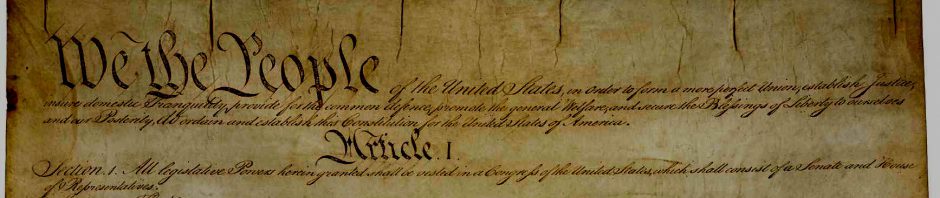
I am not a lawyer – let’s get that out of the way quickly. But I can read English, and on the subject of elections, a fourth grader can understand everything our Constitution says about them. Here’s what Article 1, Sections 4, known as the Elections Clause, says about Congressional elections, specifically the 2026 midterm elections:
The Times, Places and Manner of holding Elections for Senators and Representatives, shall be prescribed in each State by the Legislature thereof; but the Congress may at any time by Law make or alter such Regulations, except as to the Places of chusing Senators.
That’s everything the Constitution has to say about elections. Except for the archaic spelling of “choosing,” it’s pretty simple to understand.
The first thing to note about the Elections Clause is that it explicitly omits the Executive Branch of our government; that is, the Constitution grants no role to the President and Cabinet in how our elections are conducted. But there is more to say about the role of Congress.
The Committee on House Administration, part of the House of Representatives which is controlled by Republicans, says about Congress’s role:
Republicans [!!] believe that every eligible voter who wants to vote must be able to do so, and all lawful votes must be counted according to state law. Through an examination of history, precedent, the Framers’ words, debates concerning ratification, the Supreme Court, and the Constitution itself, this document explains the constitutional division of power envisioned by the Framers between the States and the federal government with respect to election administration. Article 1, Section 4 of the Constitution explains that the States have the primary authority over election administration, the “times, places, and manner of holding elections”. Conversely, the Constitution grants the Congress a purely secondary role to alter or create election laws only in the extreme cases of invasion, legislative neglect, or obstinate refusal to pass election laws (emphasis added.)
In case there’s a fourth-grader in your home who doesn’t get it, the last sentence makes it clear that Congress’s role in elections is only authorized in the case of extreme circumstances. As far as the Constitution is concerned, states have full authority to determine how and when elections of House Members and Senators are conducted.
Are there exceptions? One thing that has been discussed in the media, given Donald Trump’s obvious attempts to change the election process in a desperate bid to retain his majorities in Congress is that a president may at any time declare a State of Emergency that grants them special powers beyond those explicitly granted in the Constitution. The President does not require prior approval from Congress or any other body to declare an emergency, but the National Emergencies Act places restrictions on those special powers.
My friendly AI summarizes those restrictions as follows:
The president cannot suspend the Constitution, delay elections, or ignore basic civil rights.
The president must notify Congress immediately, and the Congress may vote to end the Emergency by joint resolution or by vetoing the president’s rejection of that vote.
Courts may block emergency declarations if the president exceeds his authority or breaks existing laws.
It should be a great relief to all Americans that presidents cannot delay elections on their own authority, but can they alter them? That’s the only apparently gray area in this discussion. The pattern we have seen repeatedly during Trump 2.0’s administration is that Trump issues wild Executive Orders (he’s issued 277 in twenty months) on scores of subjects, regardless of whether they are legal or constitutional and dares objectors to invoke the courts. Thus, our future as a democratic republic depends on how the Supreme Court rules on these challenges, specifically, on Trump’s request for an immediate ruling on his attempt to restrict mail-in voting.
We have seen the court duck ruling on the legality or constitutionality of Trump’s orders, most recently in the case of construction of his ballroom. The court is very skillful at finding technicalities around issuing such rulings when it suits their convenience. But before this action is taken, let’s be clear. It’s obvious from all of the above, that the court could only reasonably grant such authority to Trump if he were able to prove his claims that mail-in voting is rife with fraud. He made that argument to federal courts with regard to the 2020 election 64 times and lost all but one, which turned on an administrative technicality in the Pennsylvania election.
If the Supreme Court, which had a 33% approval rating in July’s Gallup polling retains any integrity, it seems almost impossible that Trump can prevail on mail-in voting. If the Court finds a way to enable such a gross violation of the Constitution which could deprive millions of Americans of the right to vote, we can kiss our so-called democracy goodbye.


